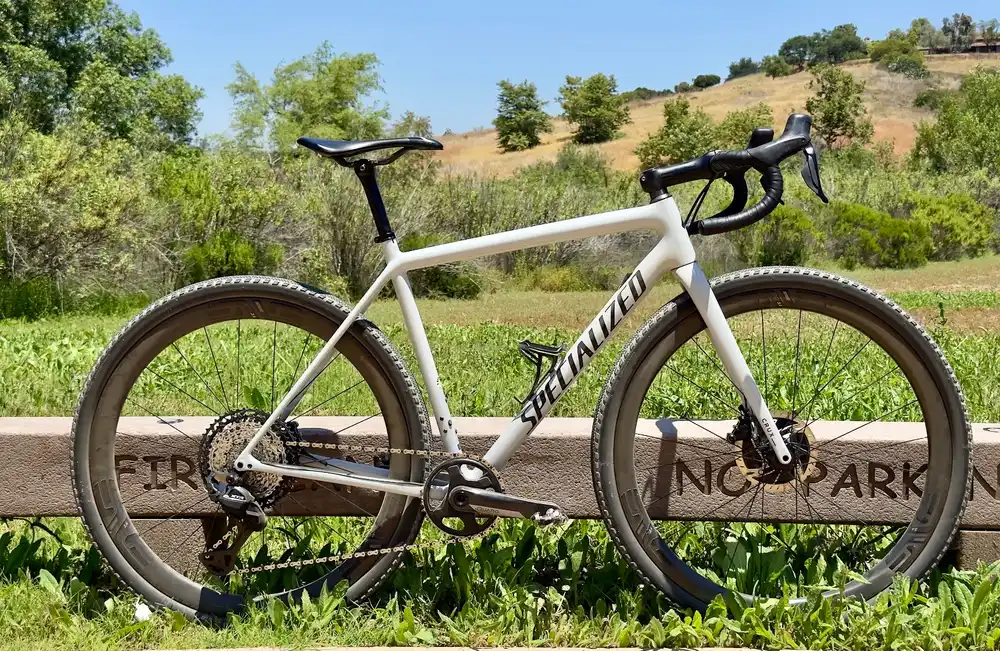
That’s my old Crux leaning on a fence post in the photo up top — no aero tube shaping, no wind tunnel time, not even the current generation of the bike. And I had a great day on it.
I just finished writing up the new Canyon Grail, and buried in the press materials was a stat that stuck with me more than the tire clearance number did: Canyon tested the bike in a wind tunnel with a pedaling mannequin, simulating yaw angles up to 20 degrees, to chase watts at a race pace of 35 km/h. That’s a genuinely sophisticated piece of engineering. It’s also a lot of institutional effort spent on a question I’m not sure enough people are asking: faster toward what?
This isn’t a Canyon problem specifically. Every gravel race bike launched in the last two years has come with a wind tunnel story, a mannequin, a rival brand’s bike as the control, and a watts-saved number that lands somewhere between three and eight. Cervélo did it with the Aspero-5. Specialized did it with the Crux. Factor did it with the Ostro before it got replaced. It’s become the required press release beat, the same way “stiffer and lighter” was the required beat a decade ago. And I get why — it’s a real, testable, defensible number that makes for a clean headline. But gravel riding, as a sport, has a physics problem that road racing doesn’t, and I don’t think the bike industry is being honest about it.
Aero matters when you’re not the one deciding your speed
On the road, at a sustained 35-40 km/h on a road surface, drag genuinely dominates. You’re producing power against a mostly constant, mostly predictable resistance, and shaving watts off that resistance translates directly into speed or energy saved over hours. That’s why road aero claims, whatever you think of the wind tunnel theater around them, are at least measuring something that maps onto how the bike is actually ridden.
Gravel doesn’t work like that, and least of all on the parts of a gravel course that actually decide who wins or who has a miserable day: the descents. Going downhill on loose surfaces, your speed is set by traction, sightlines, and how much braking you’re willing to do into a blind corner over broken rock — not by your frontal area. Aero drag scales with the square of your speed, but on a technical descent you’re not holding a tunnel-tested tuck at a constant velocity, you’re modulating brakes and picking lines. The bike that wins that section is the one with predictable handling and a tire that won’t wash out, not the one that tested best at zero-degree yaw on a trainer. Canyon’s own numbers only claim an advantage at a steady simulated race pace — which is a fair thing to test, but it’s also the flattest, most controlled slice of what a gravel race actually is.
Where I think the aero chase is genuinely earning its keep is the flat and rolling sections and the long grinding fire-road climbs, where gravel racing actually does resemble a road time trial with dirt under the tires. If you’re racing Unbound or SBT GRVL competitively, five watts over nine hours is real time. I don’t want to pretend that’s nothing. But that’s a narrow slice of the audience buying these bikes — realistically, a small number of us who own a gravel bike ever line up at an actual gravel race, and of the people who do toe the line, most aren’t there chasing a podium either. They’re there for the finisher photo and the story, same as most marathoners. The marketing doesn’t narrow itself to any of that. It sells the wind tunnel story to everyone, including the person whose longest gravel day is a Saturday loop with some friends and a coffee stop.
The tire clearance question is the more honest one
This is where I think the new Grail is actually onto something real, separate from the aero pitch. Wider tires at lower pressure genuinely reduce rolling resistance on rough surfaces, and they add real confidence and comfort that has nothing to do with a wind tunnel. Going from 42mm to 57mm of clearance isn’t a marginal gain — it’s a meaningfully different riding experience on the kind of terrain gravel bikes actually see. That part of the pitch, I buy without much skepticism, and it’s the upgrade that actually matters to how the bike feels on a Saturday ride, wind tunnel or not.
Mountain biking already settled this argument
Here’s the part that actually bothers me about the wind tunnel arms race: go stand at any trailhead on a Saturday and look at what mountain bikers are running. Some have a computer mounted, fewer have a heart rate strap, and a power meter is genuinely rare outside of the XC race crowd. Nobody’s out there deciding their line through a rock garden based on a normalized power target. Mountain biking, as a culture, mostly made peace a long time ago with the idea that the point is flow and terrain and a good time with your friends, not a number on a screen — and it didn’t stop mountain bikes from getting better. Geometry, suspension, and tire tech all kept improving without needing every launch to come with a wattage claim attached.
Gravel doesn’t have that same permission structure yet, and I think it’s because the category grew out of road racing’s marketing playbook instead of mountain biking’s. Road culture is built around data — FTP, normalized power, aero watts — because road racing genuinely rewards steady-state efficiency and because computers and power meters have been standard road kit for over a decade. Gravel inherited that instrumentation and that framing by default, even though a huge share of the people actually buying these bikes are doing exactly what mountain bikers do: riding dirt for the adventure of it, not to shave time off an effort they’re not actually racing. If you’re one of the people who’s never plugged a power meter into a gravel bike and has no plans to, you’re not an edge case. You might be the actual center of this market, just not the one the press releases are written for.
So here’s where I’ve landed: the wider tire clearance on bikes like this Grail is a legitimate, real-world upgrade, independent of anything the wind tunnel claims. But the watts-saved number attached to it is mostly there for the small slice of people actually racing at the front of Unbound, not for the rest of us. If your gravel rides look more like a mountain biker’s Saturday than a road racer’s structured block — no computer, no power target, just picking a fun loop and seeing how the legs feel — you’re not missing out on anything by ignoring the aero pitch entirely. That old Crux up top has none of the aero engineering in this year’s model, and it didn’t cost me a single good moment on the trail. Buy the tire clearance if you want it. Skip the marketing about what it’s for.