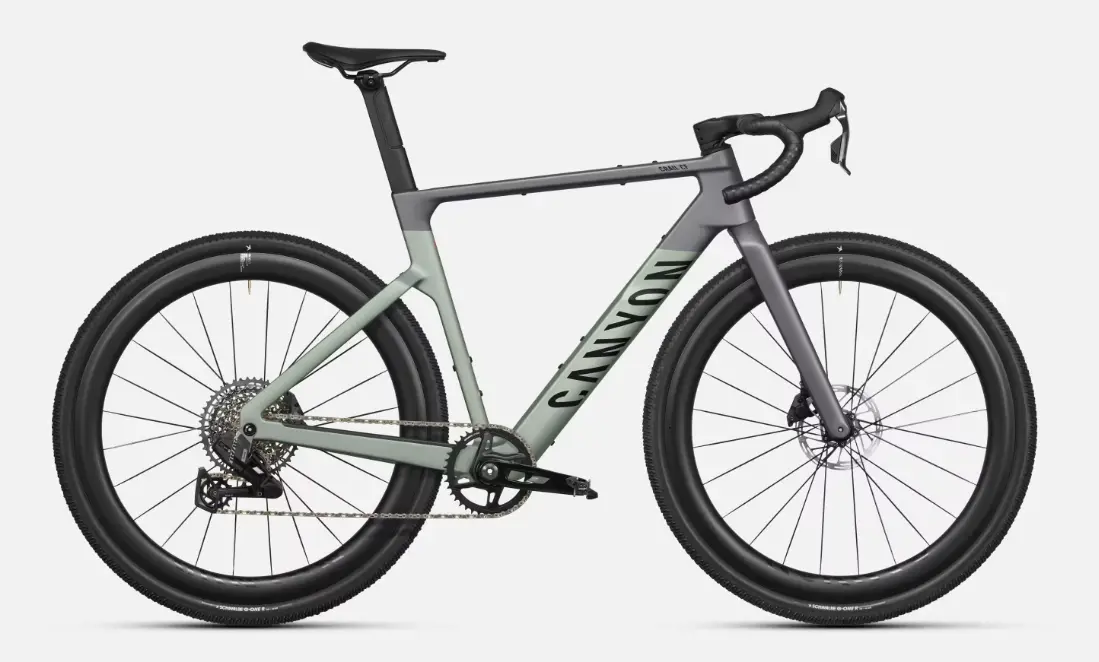
We’d been watching this bike show up in the wild for months — a Traka 360 start line here, a blurry Eurobike hallway shot there — and today Canyon finally made it official. The third-generation Grail is out, and the headline change is the one every gravel racer with wide tires and a dream has been asking for: clearance jumped from 42mm to 57mm, enough for a 2.25-inch mountain bike tire if you want to run one. That’s not a trim update. That’s Canyon admitting the second-gen Grail was already outgunned by where gravel racing actually went.
If you followed our earlier look at the Grail CFR prototype racing at Traka, you already know the shape of this bike. What’s new today is the full picture: the reasoning behind it, the spec sheet, and the price.
Why the clearance jump actually matters
Canyon’s pitch is that gravel doesn’t have the same gap between what the pros need and what the rest of us ride that road racing does. Their example: Ted King won the 2018 Dirty Kanza 200 on a cyclocross bike with 38mm tires in just under 11 hours. This year, Mads Würtz Schmidt won the same race — now Unbound — in 9 hours 14 minutes on a Specialized Crux running 50mm rubber, in worse conditions. The tires got wider because wider is faster once the surface gets rough, and Canyon is betting that logic holds for everyone racing gravel, not just the sponsored athletes.
The person actually driving that logic at Canyon, by their own account, is gravel pro Rosa Klöser, who reportedly made clearance above 50mm a non-negotiable when she signed with the team. Getting there wasn’t free: the new Grail is 1x-only now, and Canyon had to build a solid, non-dropped driveside chainstay to make the wider tire fit — a first for the brand. If you were hoping the Grail would keep its 2x option for long fire-road climbs, that’s gone. This is a bike built around one chainring and clearance, full stop.
The bottom bracket also moved to PF86, which Canyon frames as a clearance-and-stiffness call rather than a reliability regression — the company’s stated position is that bonding BSA threads into carbon brings its own long-term failure modes, tire clearance aside. Worth watching how that ages, but it’s a defensible engineering argument, not just a cost-cutting one.
The aero claims, and why I’m skeptical but not dismissive
Canyon ran the new Grail through the GST wind tunnel against a Cervélo Aspero-5, a Rose Backroad FF, and the (now-discontinued) Factor Ostro Gravel, all set up with matching 50mm wheels and 45mm tires, and says the Grail came out fastest of the group. Compared to its own second-generation Grail running 40mm tires, Canyon claims up to 5 watts saved at a simulated 35 km/h gravel-race pace — and says the new bike is still faster than the old one even when you fit it with 55mm tires, which is the more honest comparison given the wider clearance is the whole point.
Five watts is a real number if it holds up outside a brand’s own wind tunnel, but it’s also exactly the kind of figure that tends to shrink once independent testers get a bike on rollers. I’d treat it as directionally true — wider tires and a tire-shaped frame at gravel speeds probably do beat a narrower setup — without assuming the gap is exactly five watts on your local fire road.
Geometry didn’t move much, which Canyon says is intentional since the second-gen Grail’s handling was already well liked. The wheelbase grew 10mm to make room for the tires, stack dropped 15mm with shorter stems fitted at each size, and reach stayed put. Mid-size frames run a 71.5-degree head angle with 69mm of trail. No suspension fork option exists or is planned — Canyon’s stance is that at 57mm of tire clearance, you don’t need one.
Cockpit, seatpost, and the small stuff that adds up
The Pace cockpit carries over but gets a new drop shape, Control Drops, with 17 degrees of flare and three width options at the drops. Canyon also ported the VCLS Aero seatpost over from the new Endurace CFR, claiming 25% more compliance than a rigid post — a nice inheritance from the road side rather than a gravel-specific reinvention. Frame storage got smaller and lighter too: the new Cyclite-designed frame bag is claimed at roughly 100 grams against 300 grams for the old bag, swapping Fidlock for a push-to-release latch that’s meant to let race support crews swap bags fast at feed stations.
Canyon’s also launching its own carbon gravel wheelset alongside the bike, the GR 50 CF — 1,675 grams a pair, DT Swiss 350 hubs, hookless at 27mm internal width, sold separately for €999 with a 10% discount if you’re trading up from an existing Canyon gravel bike on alloy wheels. And in a genuinely useful (if very 2026) touch, there’s a new tire pressure calculator built with Pirelli, aimed at the fact that most riders still run their gravel tires too hard for the sag they actually want.
Specs and pricing
Frame weights actually went up compared to the outgoing Grail — 989g claimed for a raw CFR frame, versus a lighter number on gen 2 — which Canyon isn’t hiding, arguing the aero and clearance gains net out to a faster bike anyway. Six builds are available at launch, from the SRAM Red XPLR AXS-equipped CFR AXS at $8,999 with a claimed 7.9kg weight, down to the Shimano GRX mechanical CF 7 at $3,499. In between: the Shimano GRX Di2 CFR at $7,999, a SRAM Force XPLR AXS CF SLX 8 at $5,999, a GRX Di2 CF SLX 7 at $4,999, and a SRAM Rival XPLR AXS CF 7 at $4,299. Seven sizes are offered, said to fit riders from about 5'2" to 6'8".
Where this lands for most people reading this: if you already own a 40mm-tire Grail and aren’t racing at the pointy end, I wouldn’t rush to upgrade on the aero numbers alone. But if you’ve been eyeing a Crux or an Aspero with real tire clearance and wanted Canyon’s fit and price point instead, this is finally the bike that competes on the same terms. I’ll have more once I’ve actually got tires on gravel with one — for now, this is what changed and why.