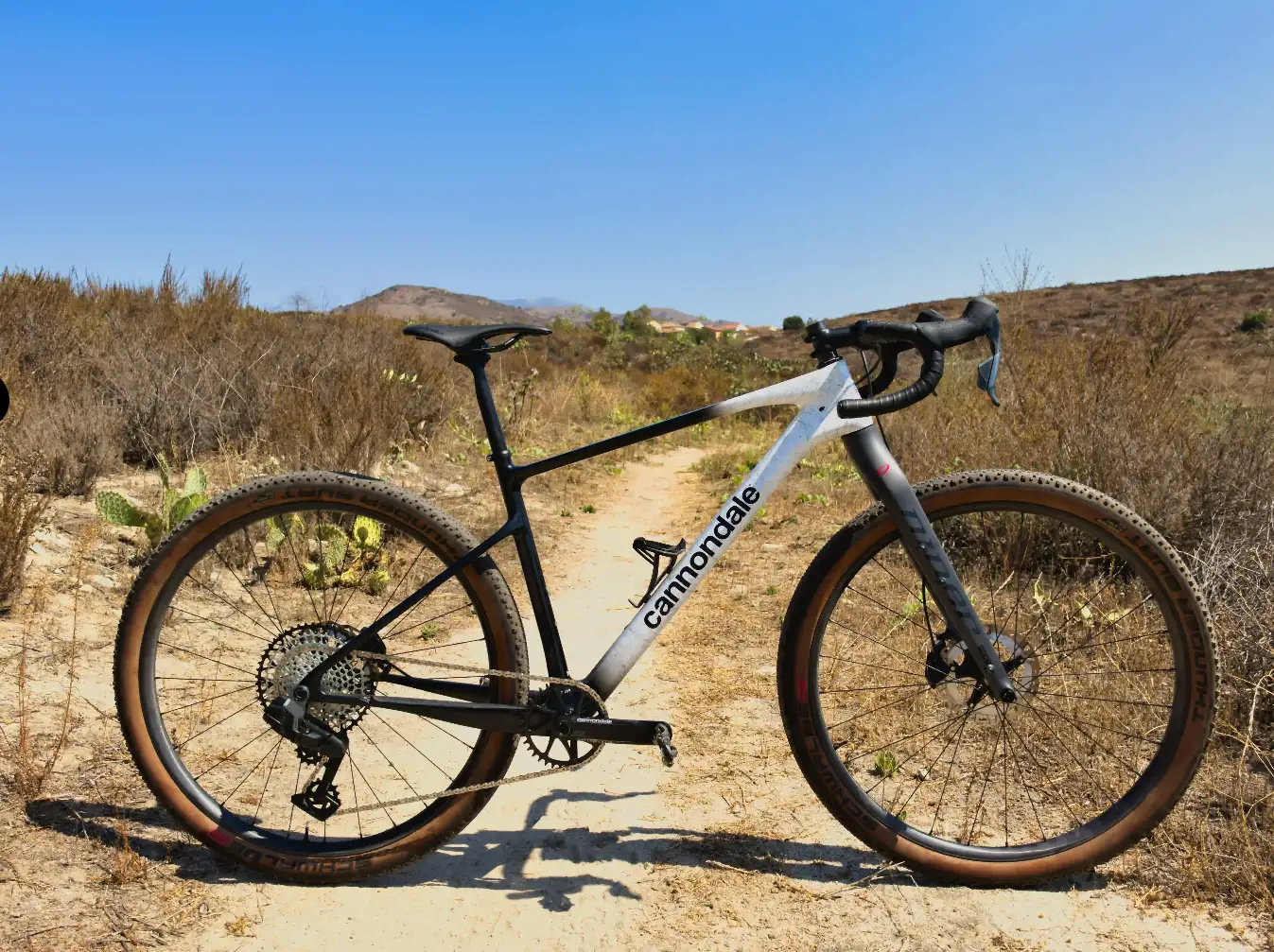
Can a hardtail make a good gravel bike? I had a Cannondale Scalpel HT Hi-Mod frame collecting dust, so I stopped wondering and built one. It now has a rigid carbon fork, drop bars, SRAM Rival XPLR AXS, and Garbaruk’s new 13-speed cassette with a 10-52 spread. On 2.25-inch tires, with pedals, it weighs 18 lb 7 oz (8.36 kg).
That number surprised me. This isn’t a Red build or a weight-weenie parts list. It’s a mid-tier group on a mountain bike frame I bought cheap, and it lands right where most stock carbon gravel bikes do.
Watch on YouTube: MTB to Gravel Conversion Build | Cannondale Scalpel HT + Garbaruk 10-52
Disclosure: Garbaruk provided the cassette and chainring for this build at a 50% discount. They had no input on this post or the video, and everything here is my own opinion. Some links below are affiliate links, and Mizu Bikes may earn a small commission if you buy through them, at no extra cost to you.
Why start with a hardtail?
Hardtails have almost disappeared from XC racing. Full suspension won that fight, which means good carbon hardtail frames show up on the used market for not much money. If you’ve got one sitting around, or can find one, you’re starting with a light, stiff frame that already clears bigger tires than most gravel bikes.
The real reason this build exists, though, is the cassette. More on that in a minute.
Turning any mountain bike into a drop bar bike comes down to three problems: brake mounts, a cockpit that tames the long reach and tall stack, and a drivetrain that pairs road shifters with mountain gearing. Solve those three and the rest is a normal build.
The build
| Part | Spec |
|---|---|
| Frame | Cannondale Scalpel HT Hi-Mod, large (bought used) |
| Fork | Niner RDO carbon rigid, Boost, tapered, post mount |
| Groupset | SRAM Rival XPLR AXS 13-speed (Full Mount) |
| Cassette | Garbaruk GEN2.0 10-52, 13-speed, XD/XDR |
| Crankset | Cannondale Hollowgram SI SL |
| Chainring | Garbaruk direct mount for Cannondale |
| Bottom bracket | Cannondale PF30 |
| Brake adapters | Wolf Tooth post to flat mount (+20 mm) |
| Rotors | 180 mm front and rear |
| Wheels | BTLOS WM-i30AS carbon, DT Swiss 350 hubs, 30 mm internal |
| Tires | Schwalbe Thunder Burt 29 x 2.25" (~57 mm) |
| Stem | 70 mm |
| Chain | SRAM Flattop 12/13-speed, 118 links |
| Complete weight | 18 lb 7 oz (8.36 kg) with pedals |
The front end: fork, brakes, cockpit
Most of the real work on a conversion happens up front, because the fork, brakes, and bars all affect each other.
The fork turned out to be the easy part. Rigid carbon forks made for hardtails are usually built with an axle-to-crown that mimics a suspension fork at sag, so your geometry doesn’t get wrecked. I used a Niner RDO carbon fork in Boost spacing with a tapered steerer and post mount brake tabs. It’s designed to sit about where a 100 mm suspension fork rides when sagged, which matches what the Scalpel was built around.
Brakes are where most people get stuck. Gravel and road hydraulic levers come with flat mount calipers, and mountain bike frames and forks use post mount. They simply don’t bolt together. You can chase down post mount calipers that work with road levers, but they don’t always feel the same and it ends up costing more. I went with Wolf Tooth’s post to flat mount adapters, about $40 apiece. The catch is that they push the caliper out by 20 mm, so you go up one rotor size from whatever the mount was designed for. My 160 mm setup became 180 mm front and rear. That’s not a bad thing on a bike that’s going to see long descents, but plan for it when you order rotors.
Before cutting the steerer, I assembled the headset, stem, and spacers the way I wanted to ride them and marked the cut. I left it long on purpose, with spacers both above and below the stem. You only get one shot at cutting a carbon steerer, and I’d rather live with a stack of spacers for a few weeks than find out I went too low. I cut it with a hacksaw and a Park Tool CSB-1 carbon blade, then dressed the edge with sandpaper. Carbon steerers get an expanding compression plug, never a star nut.
The cockpit is where the mountain bike frame works against you. I ride a large Scalpel because I like a long reach on the trail, but a mountain bike front end is already longer and taller than a road bike’s, and drop bars add their own reach on top. On my road bike I run a 120 mm stem. Here I had to go all the way down to 70 mm to get my hands where they belong. If you’re shopping for a frame specifically for this, think about sizing down.
From there it’s standard work. The rear hose routes through the frame with a foam sleeve so it doesn’t rattle, the calipers go onto the adapters loosely so they can be centered later, and both hoses get cut with a hydraulic hose cutter and connected at the levers with the threaded barb and reverse-thread olive. Since I cut both hoses to length, both brakes needed a full bleed.
Why the Garbaruk cassette is the point of this build
Here’s the problem the cassette solves. SRAM’s own 13-speed XPLR cassette tops out at 10-46, a 460% range. That’s plenty for a lot of gravel riding, but riders who want true low-end climbing gears have mostly ended up bolting on an Eagle derailleur and a 10-52 mountain cassette. That gets you the range, but you drop to 12 speeds and give up the tighter steps that make XPLR worth having.
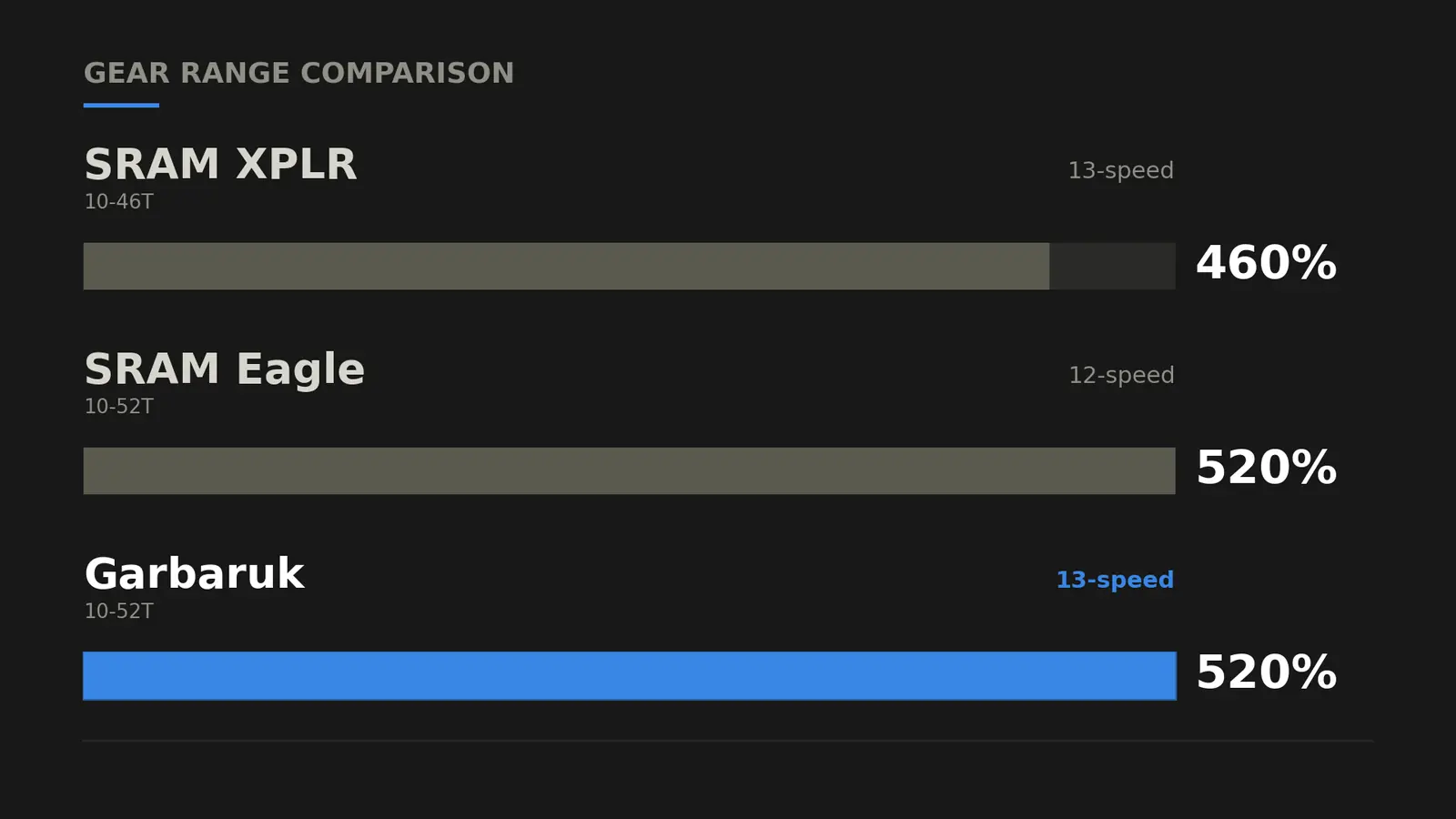
The Garbaruk 10-52 keeps all 13 gears and gives you Eagle’s 520% range: 10-11-12-14-16-18-21-24-28-32-37-44-52. List price is $409, about $100 more than SRAM’s $305 Force XPLR 10-46. It’s also a few grams lighter, at a claimed 343 g against 347 g for the SRAM. Paying more for a lighter part with a much bigger range is a trade I’d make every time.
The construction is smart. The first twelve cogs are machined from one piece of chromoly steel. The 52-tooth cog is 7075-T6 aluminum and replaceable on its own. That matters, because the bail-out cog is the one you’ll actually wear out on steep climbs, and replacing one cog is a lot cheaper than a whole cassette.
Compatibility is better than I expected. Rival and Force XPLR rear derailleurs work with their stock cages. Red is the exception: its carbon cage is too thick to clear the 52, so Red owners need Garbaruk’s replacement cage. The cassette also fits both XD and XDR freehubs, and ships with a 1.8 mm spacer for XDR. Mountain hubs usually come with XD, so I didn’t have to buy the XDR body I’d been planning on.
There is one modification, and I wish I’d known about it going in. The cassette doesn’t just bolt on. You have to pull the plastic cage cover off the Rival or Force derailleur and swap in a replacement pulley bearing cover that comes in the box. Garbaruk documents it on their site and it really is a five-minute job. Just don’t expect to install the cassette and go.
Drivetrain install and two open questions
Pairing the AXS parts is quick. Battery into the derailleur, hold its button until it flashes green, then hold the small inner button on each shifter until it flashes green fast. Press the derailleur button once more to exit pairing. The derailleur then bolts on loosely, since its final rotation gets set after the chain is on.
The Scalpel uses a PF30 press-fit bottom bracket, and I paired it with a Cannondale Hollowgram SI SL crankset. It’s aluminum, so it’s durable, and it’s still impressively light by current standards. I added Garbaruk’s direct mount chainring for Cannondale. It isn’t required to run the cassette, but the machining is gorgeous, Garbaruk claims its taller teeth hold the chain better, and it’s a bit cheaper than Cannondale’s own ring. Crank and ring together come in under 500 grams.
Two parts of this setup are honest unknowns. First, chainline. The Scalpel is a Boost 148 frame with a 55 mm chainline, which Cannondale pushed outboard for tire and chainring clearance. That’s normal for a mountain bike but further out than XPLR is designed around. Second, Garbaruk doesn’t list road Flattop chains as compatible with this ring, since it was designed for mountain bike chains. Pitch and tooth profile are the same across 12- and 13-speed Flattop, so I expect it to be fine, but I’ll report back after more miles.
Chain length on a Full Mount derailleur isn’t measured by wrapping the chain. SRAM has you look it up by chainring size and chainstay length in their Full Mount chain length calculator or the AXS app. The XPLR chart stops at a 46-tooth cog, so it has no idea a 52 exists. Since the Garbaruk is so close to Eagle in size, the workaround is to select Transmission instead of XPLR. For my frame and ring that came out to 118 links, sized with a Park Tool CT-3.3.
Derailleur setup is the usual Full Mount process with one trap. The setup cog is the 21-tooth, which is the seventh cog from the largest on the Garbaruk but the sixth on SRAM’s own cassette, so count carefully. Back the thru-axle and derailleur bolt off a full turn each, pull the cage back and lock it with the gear-icon button, then tighten the derailleur to spec while holding the cage. Snug the axle back down and fine-tune indexing until every shift is clean. There are no limit screws to set, and B-tension comes from the rotation you just locked in.
Wheels and tires
The wheels are the BTLOS WM-i30AS carbon XC rims laced to DT Swiss 350 hubs, with a 30 mm internal width. The pair weighs 1,255 g with tape and valves (580 g front, 675 g rear) and costs just under $1,000 with shipping included. That’s a lot of wheel for the money.
For rubber I’m running Schwalbe Thunder Burt 2.25s, roughly 57 mm wide. They roll fast and still hook up when it gets loose. I picked that size on purpose, because 57 mm is the clearance a lot of new gravel frames are moving toward, which makes it a fair comparison. The fun part is that Cannondale rates the Scalpel for a 29 x 2.35", about 60 mm, which is more than most gravel bikes can fit. I tested how far that clearance trend has gone on my Specialized Crux build.
Weight and first impressions
Complete with pedals and 2.25-inch tires: 18 lb 7 oz. That’s right in the range of most carbon gravel bikes, and there’s plenty of room to go lighter with nicer parts.
The tradeoffs are geometry, fit, and wheels. The Scalpel is slacker than a gravel bike, so steering is a bit slower through tight corners. Getting a drop bar fit took a much shorter stem than I’d normally ride. And mountain bike rims are shallow, because aero doesn’t matter much on singletrack. If this became your only gravel bike, you could lace deeper gravel rims to mountain hubs. It’s doable, just not simple.
What I didn’t expect was how much I’d like riding it. The bike is extremely stable, especially at speed, and the Garbaruk cassette lets me climb anything I’d climb on my mountain bike. Shifting has stayed quick and precise even when I’m mashing under load.
Should you convert your hardtail?
If you already have a hardtail sitting in the garage, yes. The extra tire clearance and the stability are worth the slower handling and the fit compromises. If you’re buying a frame specifically for gravel, buy a gravel frame. You’ll get better geometry and a simpler build.
The part I’d recommend regardless of frame is the Garbaruk cassette. If you run XPLR and you’ve ever run out of gears on a steep climb, this gets you Eagle’s range while keeping 13 speeds. No new derailleur, no switch to a mountain group, just a five-minute mod. If you’re curious how 13-speed XPLR behaves at the other extreme, I ran it 1x on a road bike in my SuperSix EVO build.
I’ll keep riding this and post a full ride review once I’ve got real miles on it. If you want to catch that, subscribe on YouTube.