The one-bike-for-everything idea gets more tempting every year. Gravel bikes are lighter, frames like the Crux 5 weigh about the same as a road frame, and a second set of wheels with road tires seems like all you need. Tires and weight aren’t really the problem anymore. Gearing is.
Almost every gravel bike now comes 1x. And 1x is great. It’s simple, quiet, there’s no front derailleur to clog with mud, and I run it on my own bikes. But a single chainring makes you choose. Size it for steep gravel climbs and you run out of gears on fast road riding. Size it for the road and your low gear isn’t low enough for gravel.
Mizubikes may earn a commission from links in this post.
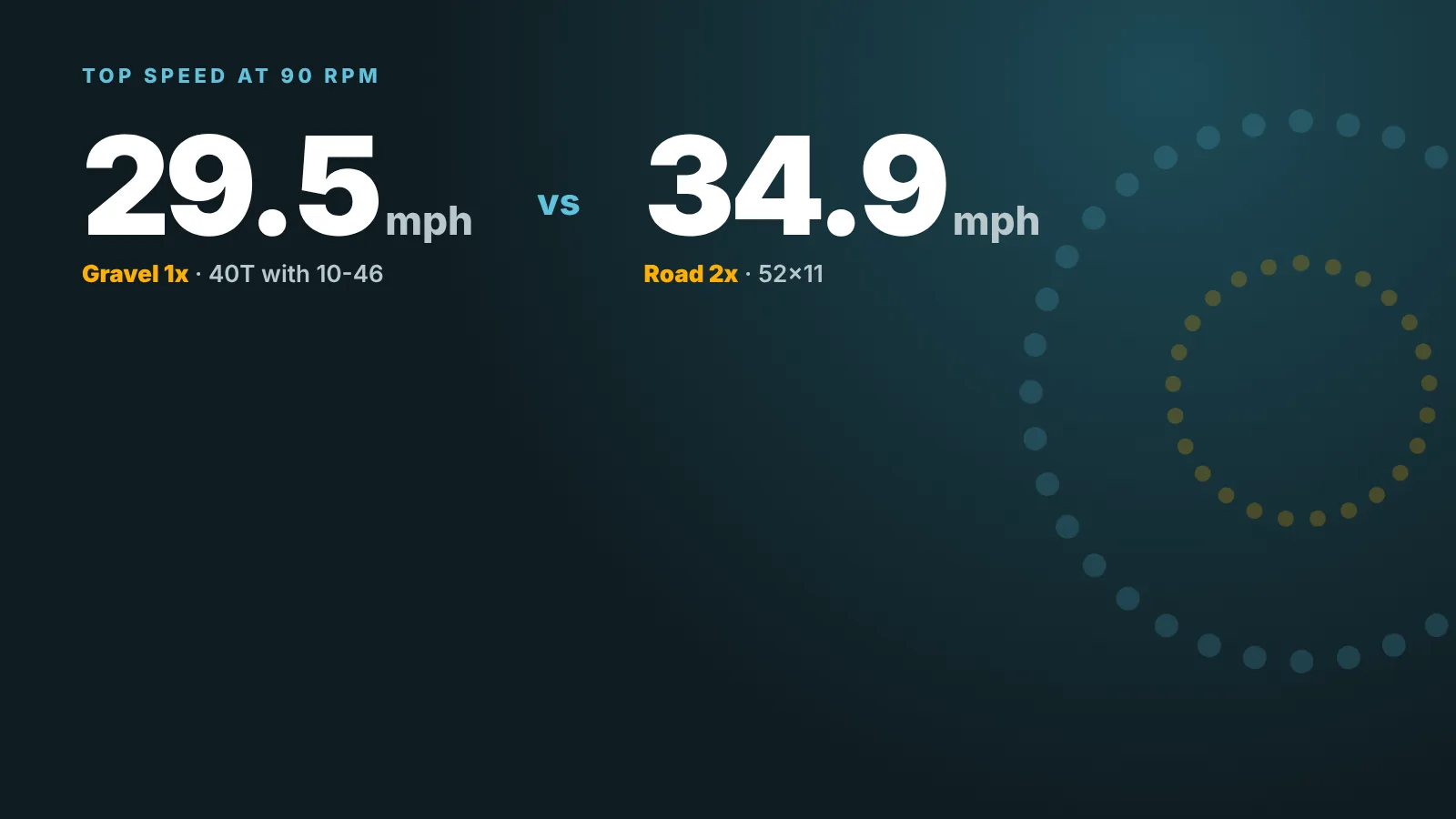
Quick answer: A gravel bike can work as a road bike, but a 1x drivetrain can’t give you both a low climbing gear and a road top end. A typical gravel setup, a 40T ring with SRAM’s 10-46 cassette, tops out at about 29.5 mph at 90 rpm. A road 52x11 gets you about 35 mph. Going up to a 46T ring fixes the top end, but your lowest gear becomes 1:1. A second wheelset with a different cassette doesn’t fully solve it either. If you really want one bike for everything, a 2x gravel drivetrain gets closest.
The numbers
 Graphic: Mizubikes
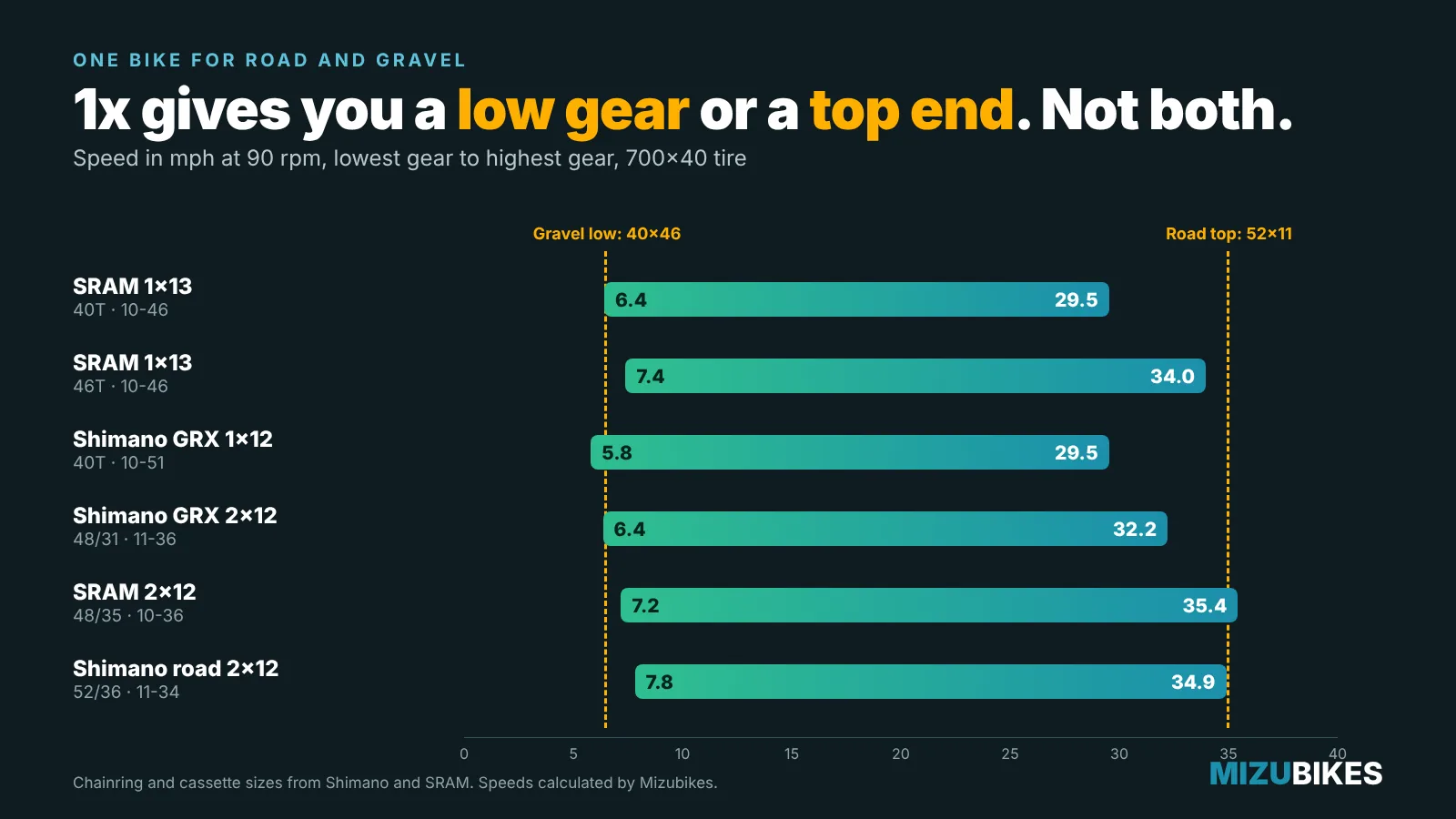
Here’s what common drivetrains give you, from the lowest gear to the highest, as speed at 90 rpm on a 700x40 tire:
| Drivetrain | Gearing | Low gear | Top gear | Range |
|---|---|---|---|---|
| SRAM 1x13 (typical gravel) | 40T, 10-46 | 6.4 mph | 29.5 mph | 460% |
| SRAM 1x13 (road-sized ring) | 46T, 10-46 | 7.4 mph | 34.0 mph | 460% |
| Shimano GRX 1x12 | 40T, 10-51 | 5.8 mph | 29.5 mph | 510% |
| Shimano GRX 2x12 | 48/31, 11-36 | 6.4 mph | 32.2 mph | 507% |
| SRAM 2x12 (wide road) | 48/35, 10-36 | 7.2 mph | 35.4 mph | 494% |
| Shimano road 2x12 | 52/36, 11-34 | 7.8 mph | 34.9 mph | 446% |
The range on SRAM’s 1x13 is actually fine. At 460%, it’s about the same as a road 2x, which I showed in 1x vs 2x road gearing. The problem is where that range sits. With one chainring, the whole range slides up or down together when you change ring size. You can’t stretch it at both ends.
For road riding, you want a top gear around 52x11, which is about 35 mph at 90 rpm. For steep gravel, especially loaded or on long climbs, you want something like a 40x46 or lower, about 6.4 mph. Covering both takes roughly 550% of range. No 1x does that.
Size the ring for gravel, lose the road top end
A 40T ring with the 10-46 is what most gravel bikes come with, and it’s a good gravel setup. On the road, though, its top gear runs out at 29.5 mph at 90 rpm, or about 33 mph if you spin at 100. That’s fine for riding alone. In a fast group ride, on a descent, or in a sprint for a town line, you’ll be spun out while everyone else is still pedaling.
Put road wheels with 28mm tires on it and it gets slightly worse. A 28mm tire has a smaller circumference than a 40mm, which drops your speed in every gear by about 3%.
Size the ring for road, lose the low gear
Go up to a 46T, and the top end is basically a road bike: 34 mph at 90 rpm. But now your easiest gear is 46x46, which is 1:1. On the road, that’s a normal climbing gear. On a steep, loose gravel climb, or with bags on the bike, it’s not low enough.
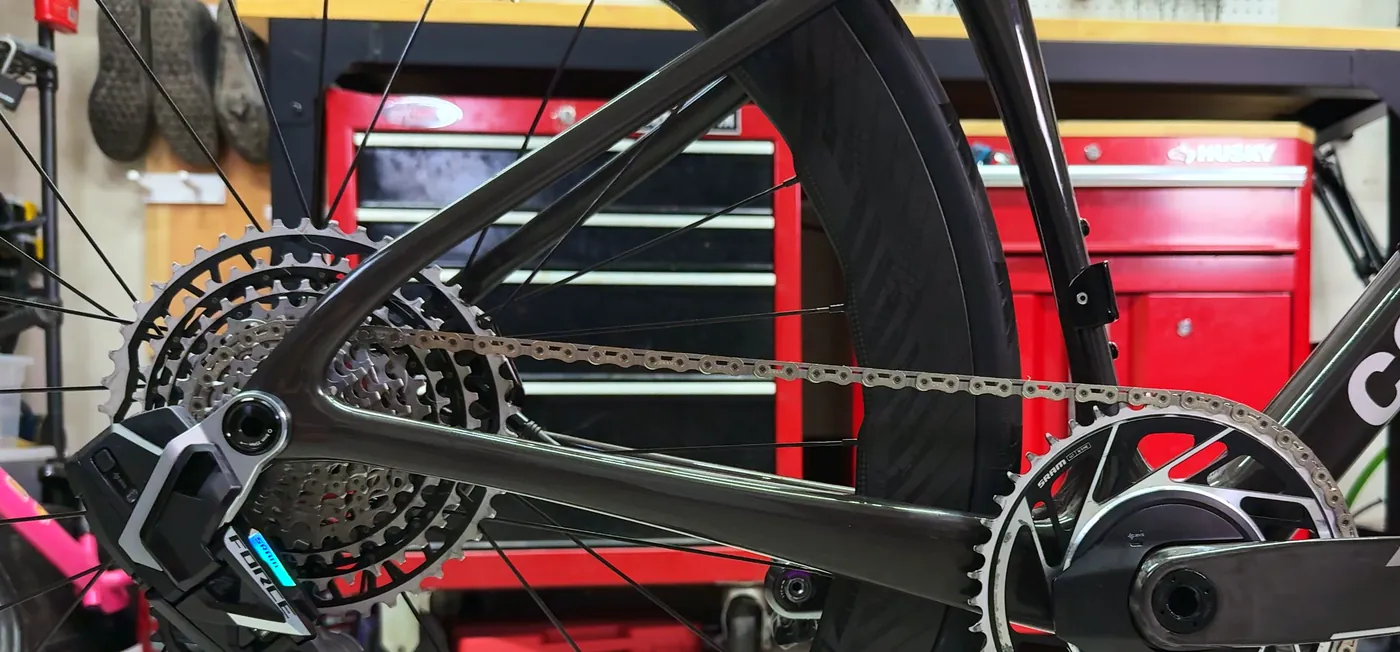 My SuperSix Evo XPLR build, set up for road. Photo: Mizubikes
That’s how I set up my SuperSix Evo with Force XPLR. It’s a road bike, so I sized the ring for the road. On a gravel bike that you also want to ride on gravel, that’s the wrong trade.
The steps between gears are the other cost. On SRAM’s 10-46, the jumps at the top of the cassette, 32 to 38 to 46, are big ones, and those are exactly the gears you’re shifting between on a long gravel climb. I went cog by cog in SRAM Force gear jumps compared.
Why a second wheelset doesn’t fix it
The usual answer is to buy a second wheelset with a road cassette. That works better in theory than in practice.
On SRAM 1x13, there’s only one cassette. SRAM’s 13-speed XPLR comes in 10-46 only, and the rear derailleur is designed for that cassette. A road wheelset would carry the same 10-46, so your gearing doesn’t change at all. The only thing you can change is the chainring, and on SRAM’s direct-mount rings that means pulling the crank.
Changing the ring means changing the chain. Going from a 40T to a 46T needs a longer chain. Then you have to redo the derailleur setup. On a 1x13 XPLR derailleur, there’s no B-tension screw, but the setup still depends on chain length, so you’re re-adjusting every time you swap.
On 12-speed, you can swap cassettes, but it isn’t plug and play. With Shimano GRX 12-speed, you can run a 10-45 on one wheelset and a 10-51 on the other. But a different cassette can need a different chain length and B-tension. So a wheelset swap turns into a chain and derailleur adjustment, and maybe a brake rub check if the rotors don’t line up the same.
And the cassette swap doesn’t really solve it anyway. On 1x, the top gear is set by the chainring and the 10T cog, and every 1x cassette starts at 10. A different cassette only changes your low gear and the steps. The top end stays the same.
Swapping wheels to go from gravel to road is easy on a 2x bike. On a 1x bike, you’re really swapping drivetrains.
What actually works
Pick your priority and size the ring for it. If you ride mostly gravel and some road, keep the 40T or 42T and accept that you’ll spin out on fast road rides. If you ride mostly road and some gravel, a 44T or 46T works and you’ll walk or grind the steepest gravel climbs. SRAM Red XPLR’s 1x rings come in 38T to 46T. Shimano’s GRX 12-speed 1x comes in 40T and 42T (38T and 40T on RX610).
Run 2x on a gravel bike. If you really want one bike for everything, 2x is still the answer. Shimano GRX 48/31 with an 11-36 has about the same 6.4 mph low gear as a 40x46, and its 32.2 mph top gear is much closer to a road bike. The steps between gears are tighter too, since the two rings split the range. You give up some simplicity, a front derailleur and a little mud tolerance, but no 1x setup gets you both ends like this. Check before you buy, because plenty of new gravel frames don’t take a front derailleur anymore.
Or put the second chainring in the hub. Classified’s Powershift hub adds a 2x-style low range inside the rear wheel, with a single ring up front. It’s heavier and proprietary, but it’s the only way to get both ends on a 1x-looking bike. I went through it on the Cannondale SuperX LTD Classified.
Or just have two bikes. If you ride road hard, group rides, races, fast descents, a dedicated road bike with a 2x is still better at it. A gravel bike with a 1x is better at gravel. The one-bike setup works best for people who ride a mix at moderate speed and don’t mind running out of gears now and then.
My take
1x isn’t the problem. It’s the right answer for gravel and a reasonable one for road. The problem is trying to make one 1x setup do both. If you want one bike, decide which half of your riding matters more and size the chainring for that. If neither half can give, get a gravel bike that takes a front derailleur and run 2x.
If you’re going with SRAM 1x13, the Force XPLR 10-46 cassette and Force AXS XPLR rear derailleur are what this all runs on. If you need to know whether your frame can run it, see which gravel frames work with SRAM 1x13. And for a direct comparison of the two main gravel groups, read SRAM 13-speed vs Shimano GRX 12-speed.
FAQ
Can you use a gravel bike as a road bike? Yes. With road tires, a modern gravel bike rides well on pavement. The main limit is 1x gearing, which runs out of top end on fast road rides if the chainring is sized for gravel.
What chainring size should I run on a gravel bike for road riding? For mostly road, a 44T or 46T with a 10-46 cassette gives you close to a road top gear. For mostly gravel, stay at 40T or 42T.
Is 2x better than 1x for a gravel bike you also ride on the road? For one bike that does both, yes. A 2x like Shimano GRX 48/31 with an 11-36 gives a low gravel climbing gear and a higher top end, with tighter steps between gears.
Can I use a second wheelset with a road cassette on a 1x gravel bike? On SRAM 1x13, no, because the only cassette is the 10-46. On 12-speed, yes, but a different cassette can need a different chain length and B-tension, and it won’t change your top gear.