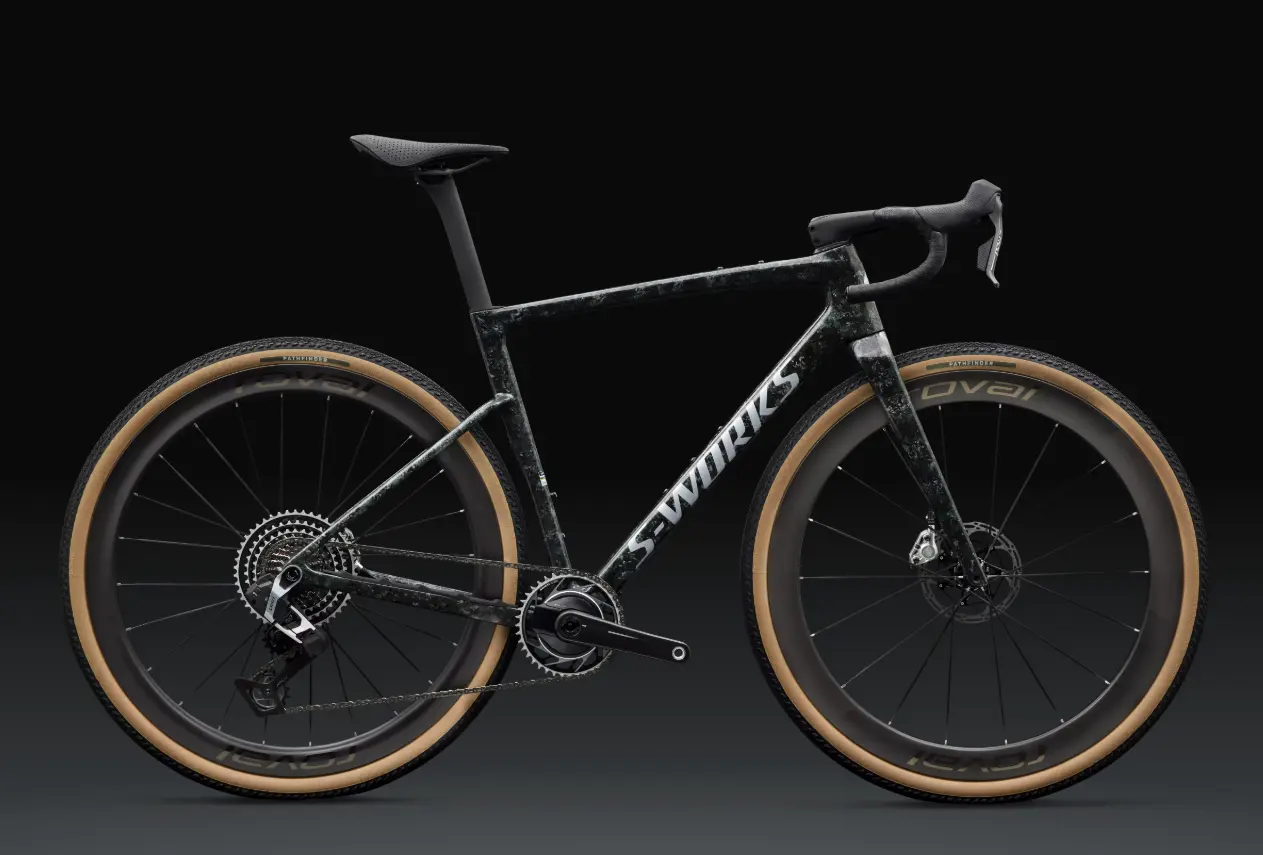
The Crux 5 launched today, and most of the coverage is focused on what it means for gravel racing. Fair enough — that’s what Specialized built it for. But I keep staring at the spec sheet thinking about a different question: at what point does a bike like this make a dedicated road bike redundant for most riders?
I think we’re getting close.
The Weight Argument Is Real
The S-Works Crux 5 frame weighs 789 grams. The Tarmac SL8 frame — one of the lightest road frames ever made — weighs 685 grams. That’s a 104-gram difference. For context, that’s roughly the weight of a CO2 inflator and a folded tire. It’s real, but it’s not the kind of gap that changes your life on a Saturday morning ride.
Meanwhile, purpose-built aero road frames like the Cervélo S5 come in around 980 grams, and the Scott Foil RC sits in similar territory. The Crux 5 is lighter than most dedicated aero road bikes — as a gravel frame. Let that sit for a second.
Slap a set of 28mm road tires on the Crux 5 and you have an aero bike that weighs less than the majority of road-only frames on the market. The complete S-Works build comes in at 7.1kg with gravel-spec rubber and gravel wheels. Swap in narrower tires and a road-oriented wheelset and you’re not losing much — if anything — to a comparable road build.
The Geometry Conversation Is More Honest Than You’d Expect
Here’s where people usually dismiss the quiver-killer argument: “the geometry is different.” And technically, yes, it is. The Crux 5 runs a 71.5° head tube angle on a size 56, the bottom bracket sits lower than a road bike, and the stack is about a centimeter higher than the Tarmac SL8. The reach has also grown on larger sizes.
But let’s be honest about who this matters for. If you’re racing criteriums — short, tight, punchy circuits where you’re sprinting out of every corner and need the bike to snap direction instantly — then yes, that half-degree difference in head angle and the longer wheelbase will feel different. You probably want a road bike for that.
For everyone else? A century ride, a gran fondo, a long training day on the roads, or even a road race that isn’t a crit? The geometry difference between the Crux 5 and a Tarmac SL8 is not something most riders will ever feel. The Crux 5’s stack is still race-bike low. One press reviewer noted they rode the bike comfortably with 20mm of spacers under the stem and could have gone lower. That’s not an endurance geometry — that’s a race position on a gravel bike.
The slacker head angle actually makes the Crux 5 more pleasant to ride on longer days. Road bikes optimized for crits can feel nervous on open roads at speed. The Crux 5’s geometry was designed to build confidence at speed on rough terrain, which also translates to confidence at speed on smooth pavement.
The Tire Clearance Makes It More Versatile, Not Less
Some people look at 55mm clearance and think “that’s too much bike for the road.” I’d flip that around entirely. 55mm clearance means you can run 28mm, 30mm, or 32mm road tires without the frame feeling oversized. The Crux 5 isn’t forced into fat tires — it just has the option. A 28mm road tire in a 55mm clearance frame is still a 28mm road tire.
And running a slightly wider tire on pavement isn’t a disadvantage anymore. The industry has moved on from the days of 23mm tires being the performance standard. Most WorldTour road racing now happens on 28mm rubber. A 30mm tire on smooth pavement at 90psi is faster and more comfortable than a 25mm tire at 110psi, and the Crux 5 handles that without any compromise.
The Honest Tradeoffs
I’m not going to pretend the Crux 5 is a perfect road bike. The 1x-only drivetrain is a real consideration if you’re doing road rides with sustained climbs — a 40-tooth front chainring with a 10-44 cassette covers most terrain, but it’s not the same as a well-tuned 2x road setup when you’re grinding up a long alpine climb in a big group. The gearing works; it just requires more thought.
The aero seatpost is also fixed — no dropper compatibility, and you’re locked into the integrated cockpit system if you want the full aero benefit. That’s fine for road riding, but it’s worth knowing the platform has constraints.
And yes, if you race crits or technical road criteriums regularly, keep your road bike. The handling difference is real in that context and it matters.
But for Most of Us
Most riders who own both a road bike and a gravel bike aren’t racing crits. They’re doing long weekend rides, gravel routes, the occasional gran fondo, and trying to limit how much garage space their hobby consumes. For that rider, the Crux 5 with a second set of road wheels isn’t a compromise — it’s an upgrade in both directions.
You get a better gravel bike than whatever you’re currently running. And you get a road bike that’s lighter and more aero than most dedicated road frames at this price point, without buying a second complete bike.
The two-bike quiver of road and gravel made sense when the categories were more distinct. The Crux 5 is evidence that the lines are blurring fast. I don’t think we’re quite at the point where one bike genuinely does everything — the 1x drivetrain and the integrated cockpit still impose some constraints. But we’re close enough that the question is worth asking seriously.
For a lot of riders, the honest answer might be: one Crux 5, two wheelsets, and a lot more money left in your pocket.