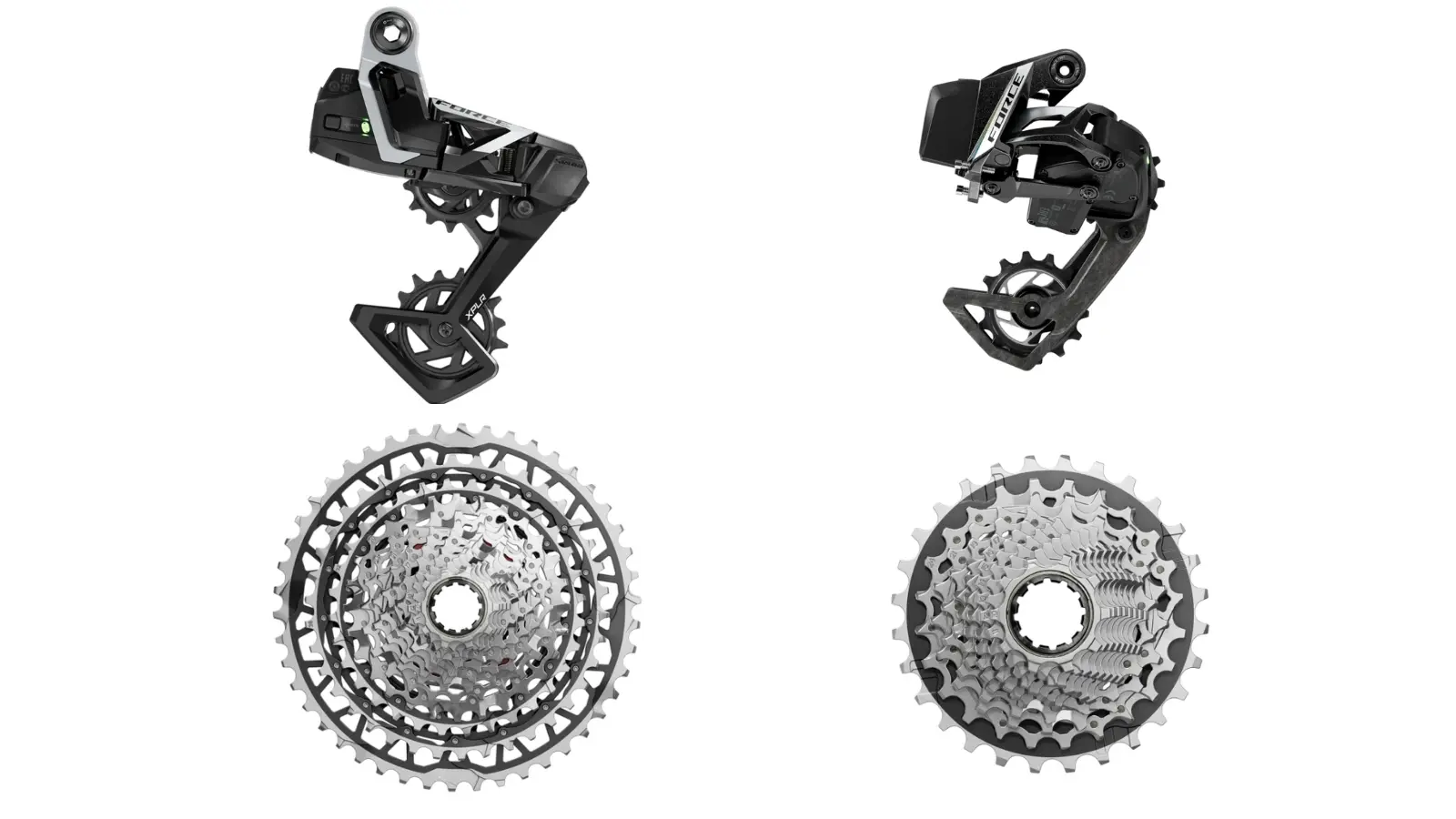
In my last post about switching to SRAM Force E1, I compared the setups I’m considering using range percentages — 494% for the 2x, 460% for XPLR, and so on. Range is the number every manufacturer prints on the box, and it’s also the least useful number for deciding what to actually ride. Two drivetrains with identical range can feel completely different, because range tells you nothing about where the gears sit between the extremes.
The number that matters day to day is the jump: how much your cadence changes every time you click the shifter. Say you’re cruising at 90 rpm and you shift into a harder gear. A 10% jump drops you to about 82 rpm — barely noticeable. A 21% jump drops you to 74 rpm, which is the difference between pedaling and lugging. Every cassette design is a decision about where to hide the big jumps, and once you see where SRAM hid them in the E1 lineup, the whole 2x vs 1x question gets a lot clearer.
Three cassettes, one shared spine
Here’s the part that surprised me when I lined up the actual tooth counts. The 12-speed 10-36 road cassette and the 13-speed XPLR 10-46 are the same cassette for eleven straight cogs:
| Position | 10-33 (12s) | 10-36 (12s) | 10-46 XPLR (13s) |
|---|---|---|---|
| 1 | 10 | 10 | 10 |
| 2 | 11 | 11 | 11 |
| 3 | 12 | 12 | 12 |
| 4 | 13 | 13 | 13 |
| 5 | 14 | 15 | 15 |
| 6 | 15 | 17 | 17 |
| 7 | 17 | 19 | 19 |
| 8 | 19 | 21 | 21 |
| 9 | 21 | 24 | 24 |
| 10 | 24 | 28 | 28 |
| 11 | 28 | 32 | 32 |
| 12 | 33 | 36 | 38 |
| 13 | — | — | 46 |
The XPLR cassette is literally the 10-36 with the last cog swapped from a 36 to a 38 and a 46 stacked on top. Put another way: eleven of its thirteen cogs are identical to the road cassette, but you get one extra gear and the cassette’s range grows from 360% to 460% — about 28% more spread, all of it at the low end. That puts a single chainring within striking distance of the full 2x setup, which manages 494% with a second ring, a front derailleur, and twelve extra nominal gears. The 13-speed 1x gives up only about 7% of the double’s total range. With the 48T chainring you keep the identical 4.8 top gear and concede just a slightly taller bottom gear — 1.04 against the 2x’s 0.97. That’s a remarkable amount of drivetrain for what amounts to two cogs of engineering, and it’s why the whole 13-speed pitch works. Meanwhile the 10-33 goes the other direction — it squeezes a 14-tooth cog into the top of the stack, giving you five one-tooth jumps in a row where the 10-36 only manages four.
The jump table
Convert those tooth counts into percentage jumps and the personalities emerge:
| Shift | 10-33 | 10-36 | 10-46 XPLR |
|---|---|---|---|
| 10→11 | 10.0% | 10.0% | 10.0% |
| 11→12 | 9.1% | 9.1% | 9.1% |
| 12→13 | 8.3% | 8.3% | 8.3% |
| 13→14 | 7.7% | — | — |
| 13→15 | — | 15.4% | 15.4% |
| 14→15 | 7.1% | — | — |
| 15→17 | 13.3% | 13.3% | 13.3% |
| 17→19 | 11.8% | 11.8% | 11.8% |
| 19→21 | 10.5% | 10.5% | 10.5% |
| 21→24 | 14.3% | 14.3% | 14.3% |
| 24→28 | 16.7% | 16.7% | 16.7% |
| 28→32 | — | 14.3% | 14.3% |
| 28→33 | 17.9% | — | — |
| 32→36 | — | 12.5% | — |
| 32→38 | — | — | 18.8% |
| 38→46 | — | — | 21.1% |
Three cassettes, three different answers to the same question. The 10-33 puts its pain at the very bottom: those 7-8% steps through the 13-14-15 zone are beautiful when you’re rolling along at speed, but that final 28→33 shift is a 17.9% lurch, and it’s a jump plenty of owners have found annoying in practice — the 28 isn’t quite enough and the 33 is suddenly too much. The 10-36 spreads its compromise across the middle, with the notorious 15.4% gap between the 13 and 15 sitting right in the cruising range. And the XPLR saves everything for the end, where the last two shifts are 18.8% and 21.1% — the two biggest jumps anywhere in the E1 family.
That XPLR framing is worth sitting with, because SRAM markets the 13-speed cassette as delivering wide range and tight jumps. Both claims are true. They’re just true in different halves of the cassette. From the 10 through the 32 you’re riding road-cassette spacing, tooth for tooth. Then you hit the bailout section and each click knocks your cadence from 90 down to about 76, then 74. On a steep loose climb that’s arguably what you want — one click, big relief, no hunting. But if you’re expecting the smooth progression of the upper cassette to continue into the low gears, it doesn’t.
What the 2x actually buys you
Here’s how the full lineup shakes out once you add the 10-33 to the mix, using a 48/35 crankset for the 2x setups:
| Setup | Chainring | Cassette | Top | Bottom | Range |
|---|---|---|---|---|---|
| Force E1 2x | 48/35T | 10-33T | 4.8 | 1.06 | 453% |
| Force E1 2x | 48/35T | 10-36T | 4.8 | 0.97 | 494% |
| Force E1 1x (no XPLR) | 46T | 10-36T | 4.6 | 1.28 | 360% |
| Force XPLR 1x | 48T | 10-46T | 4.8 | 1.04 | 460% |
| Force XPLR 1x | 44T | 10-46T | 4.4 | 0.96 | 460% |
The headline argument for 2x is that 494% number, but honestly, the range isn’t the interesting part. The interesting part is what the front derailleur does to the middle of the cassette. The 48/35 chainring pair is a 37% step, which works out to roughly three cogs’ worth of cassette position. That means a front shift doesn’t just change your range — it re-centers you on the cassette, and in the process it inserts half-steps exactly where the 10-36 is weakest. The 35/10 combination lands almost perfectly between 48/13 and 48/15, splitting that ugly 15.4% gap into a 5.5% step and a 9.4% step. And that’s not an academic gear — 48/13 to 48/15 is the shift you’re making at around 26 mph.
But I’ll also be honest about the other side of the ledger, because “2x gives you 24 gears” is one of the more misleading claims in drivetrain marketing. Merge both chainrings into a single ladder and a bunch of combinations land within about 3% of each other — 48/17 sits on top of 35/12, 48/21 on top of 35/15, 48/24 on top of 35/17, and the pattern continues down the cassette. Of the 24 nominal gears, roughly 17 are actually distinct. The overlap isn’t a design flaw; it’s what makes front shifts feel seamless instead of jarring. But the truthful way to describe a 2x drivetrain is that it gives you the same ladder as the 1x, plus half-steps in the middle and a wider floor and ceiling — not double the gears.
The 46T 1x with the road 10-36 cassette is the setup I have the hardest time recommending. Its jumps are identical to the 2x big ring, so you gain nothing in spacing, and its 1.28 bottom gear gives up the entire low end — the 2x reaches 0.97 and the climbing XPLR reaches 0.96. To put that in physical terms: at 90 rpm on a 40mm gravel tire, a 0.96-0.97 ratio is about 7 mph, while 1.28 is about 9.3 mph. On a 12% fire road, that gap is the difference between spinning up it seated and standing on the pedals praying. The 46T road-cassette setup earns its keep only on a bike that lives on flat terrain, where the simplicity and chain security of 1x matter more than the missing bailout gears.
So which one am I building?
If your riding is mostly pavement and rolling terrain, the 10-33 with a 2x crank is the connoisseur’s choice — the tightest cruising spacing SRAM makes at this level, with the 2x low end backstopping that abrupt 28→33 shift. If you split time between road and dirt, the 48/35 with the 10-36 is the honest all-rounder, and the front derailleur quietly patches the cassette’s one weak spot. And if the bike is a dedicated gravel rig, the XPLR 44T setup gives you essentially the same low gear as the 2x with one less derailleur to think about, as long as you make peace with those two big jumps at the bottom and a 4.4 top gear that spins out in the mid-30s.
I’ve already tipped my hand on which direction I’m leaning in the previous post, and the full build is coming together now. Once it’s rideable I’ll report back on whether the jump math matches how the drivetrain actually feels on the road — including whether E1 finally fixed the front derailleur. If you’re pricing out cassettes in the meantime, the Force XG-1270 is on Amazon in all four sizes, and Worldwide Cyclery stocks the 13-speed XPLR 10-46 if you’re going the gravel route.