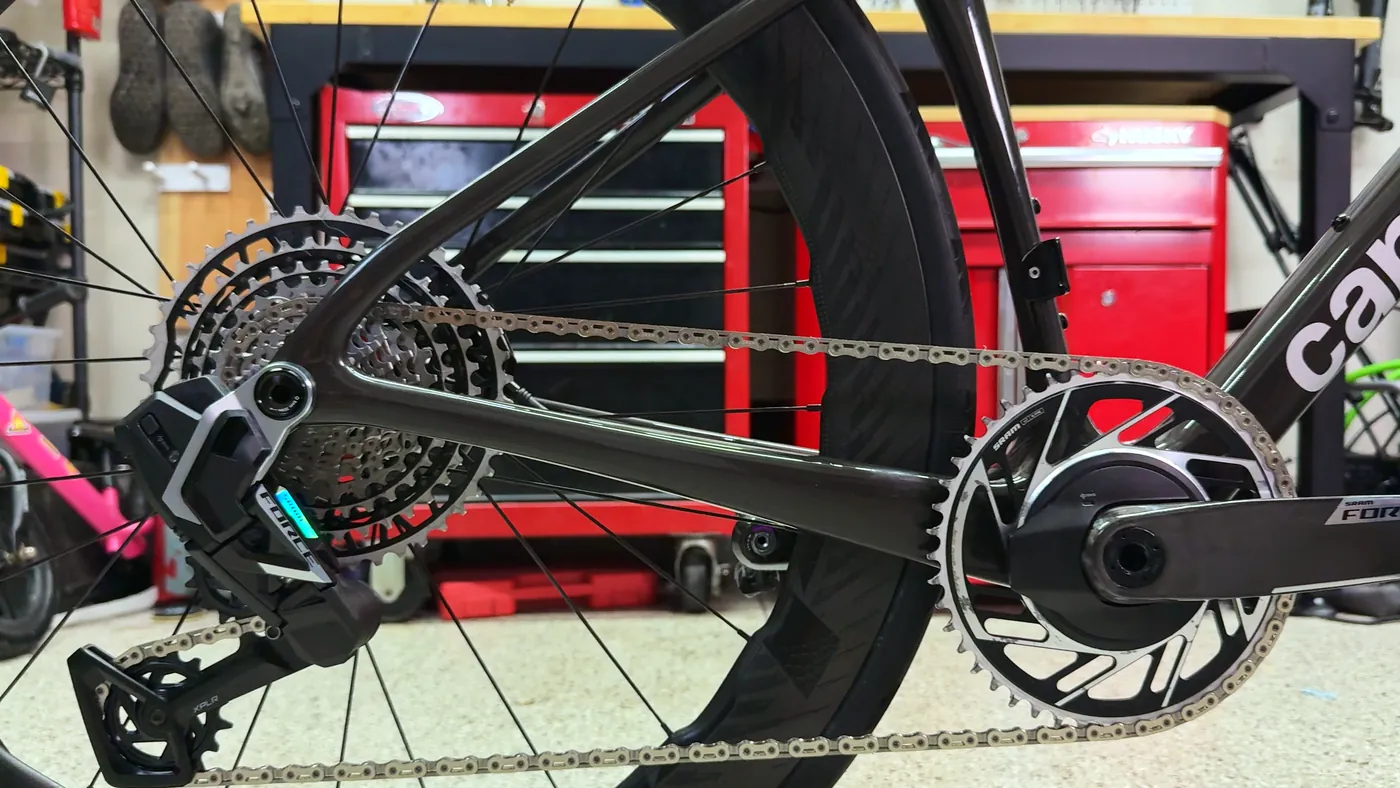
The knock on running 1x on a road bike is always the same two things: you lose range, and you get big gaps between gears. It’s why most people never seriously consider dropping the front derailleur on the road. When I built up my SuperSix Evo with SRAM’s 13-speed Force XPLR group, I wanted to stop guessing and put real numbers to both claims. Neither one held up the way I expected.
The gaps: 11 of 13 gears are identical
Start with spacing, since that’s the complaint you hear most. I lined my 10-46 XPLR cassette up against a standard 12-speed 10-36 road cassette, cog for cog. Eleven of my thirteen cogs are the exact same tooth counts — 10, 11, 12, 13, 15, 17, 19, 21, 24, 28, 32 — in the same order, with the same jumps between them.
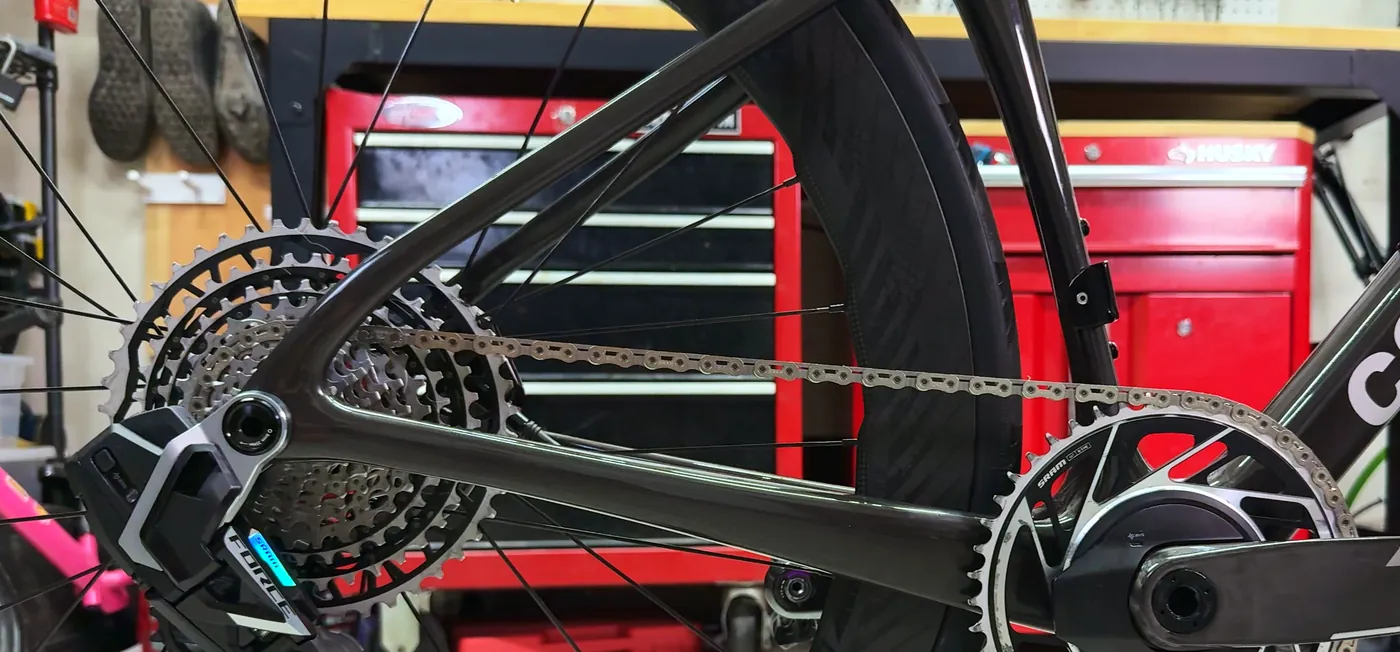 Photo: Mizu Bikes
That’s the part that reframed it for me. Through the entire flat and rolling range — the gears you actually pedal in for most of a ride — an XPLR 1x setup shifts exactly like a road cassette, because for those eleven cogs it is one. The single-ring penalty everyone warns about just isn’t there in the range where you spend your time. The difference only shows up at the very top: a road cassette caps out at a 36-tooth climbing cog, and XPLR trades that for a 38 and a 46.
The range: more than the 2x most people run
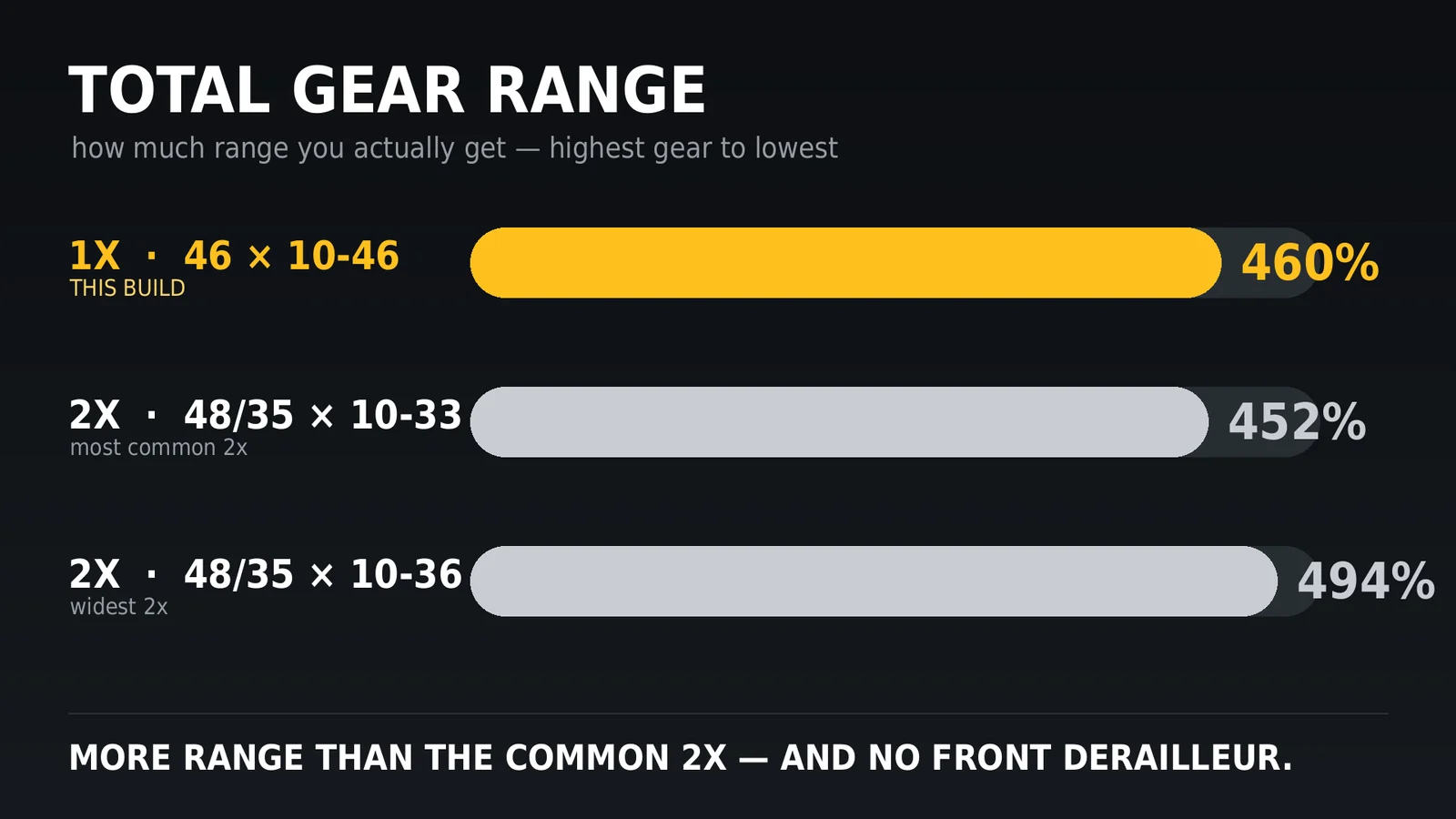 Chart: Mizu Bikes
Now total range — highest gear to lowest. My 46-tooth ring with the 10-46 cassette gives 460%. The 2x setup most road riders are actually on — a 48/35 crank with a 10-33 cassette — comes out to 452%. So against the common 2x, the single ring gives up nothing on range. It gives you slightly more, and it does it without a second chainring or a front derailleur.
Push all the way to the widest 2x anyone runs, a 48/35 with a 10-36, and you get 494%. That beats my 1x — but not by much, and you’re carrying an extra shifter mechanism, extra cabling, and a front derailleur to get there.
What you actually give up
So where’s the catch? It’s real, but it’s narrow. Those two extra climbing cogs at the top, the 38 and the 46, are big jumps sitting above the tight road spacing below them. On the flats and rollers you never touch them. But when you’re grinding up a long climb and shuffling between bailout gears, you feel the wider steps in a way you wouldn’t on a 2x. Whether that matters comes down entirely to the kind of climbing you do.
There’s a second, setup-level caveat I ran into on the build itself: XPLR is a gravel system, designed around the longer chainstays of a gravel bike. Bolt it to a short road chainstay and the chain angle in the extreme gears gets sharp enough to cost a little shift crispness. I go through that in detail in the full SuperSix XPLR build.
Is it worth it?
For a lot of road riding, the honest answer is that 1x gives up far less than its reputation suggests: road-identical spacing where you actually ride, more range than a common 2x, one fewer thing up front to fail, and a cleaner cockpit. The tradeoff is concentrated in the top two climbing gears and a bit of setup fussiness — not in the day-to-day riding most people imagined they’d lose.
If you want to run the setup yourself, the two parts that make the gearing work are the SRAM Force AXS XPLR rear derailleur and the SRAM XG-1371 XPLR 10-46 cassette. And if you want to see the whole thing built up from a bare frame, that’s the SuperSix Evo XPLR build.