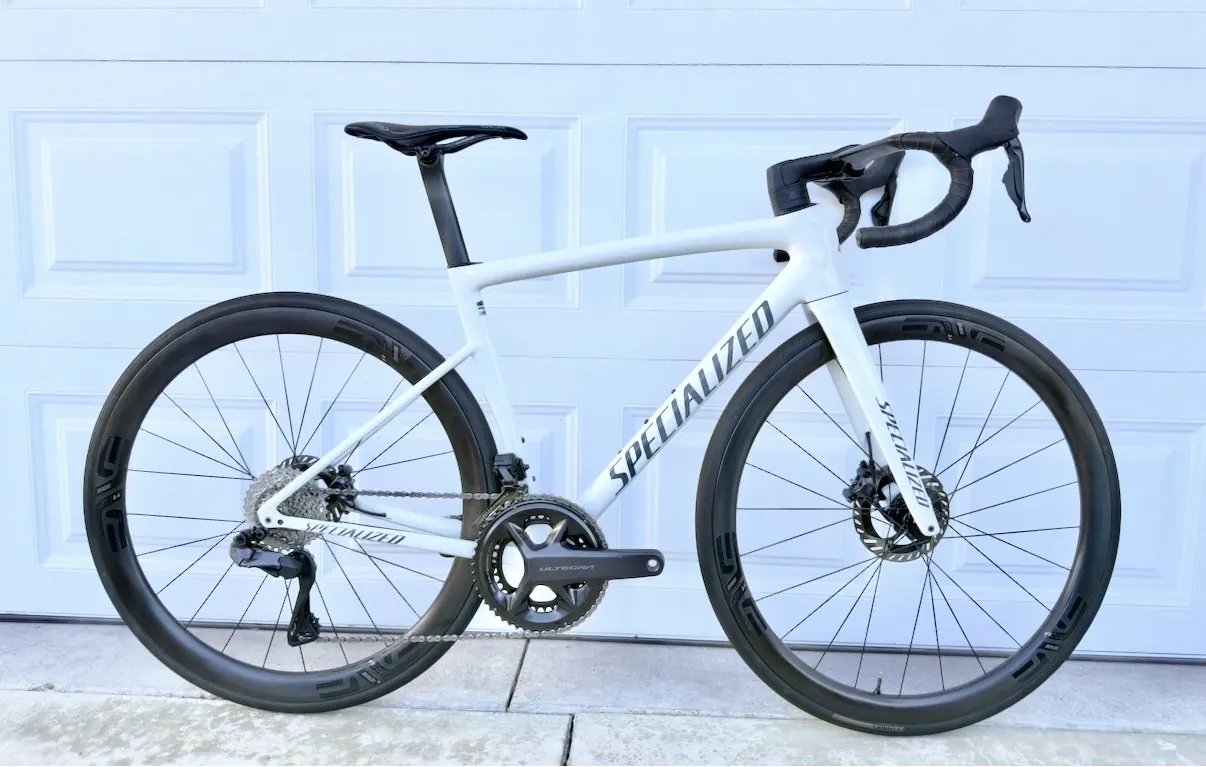
I ride a 54cm Tarmac SL8, so this one’s personal. The SL9 is out, it looks great, and I’ve been asking myself the same question a lot of SL8 owners are: is it actually worth upgrading?
Quick answer: For most SL8 owners, no. The SL9 is about 4 watts more aero by Specialized’s numbers, which works out to roughly 15 seconds per hour of riding. The frame weight, geometry, tire clearance and ride are basically the same. The upgrade makes sense if you want a UDH dropout for SRAM’s newer drivetrains, if you race and every watt counts, or if you can sell your SL8 for close to what an SL9 costs you. Otherwise, the same money spent on wheels, tires or fit will make you faster.
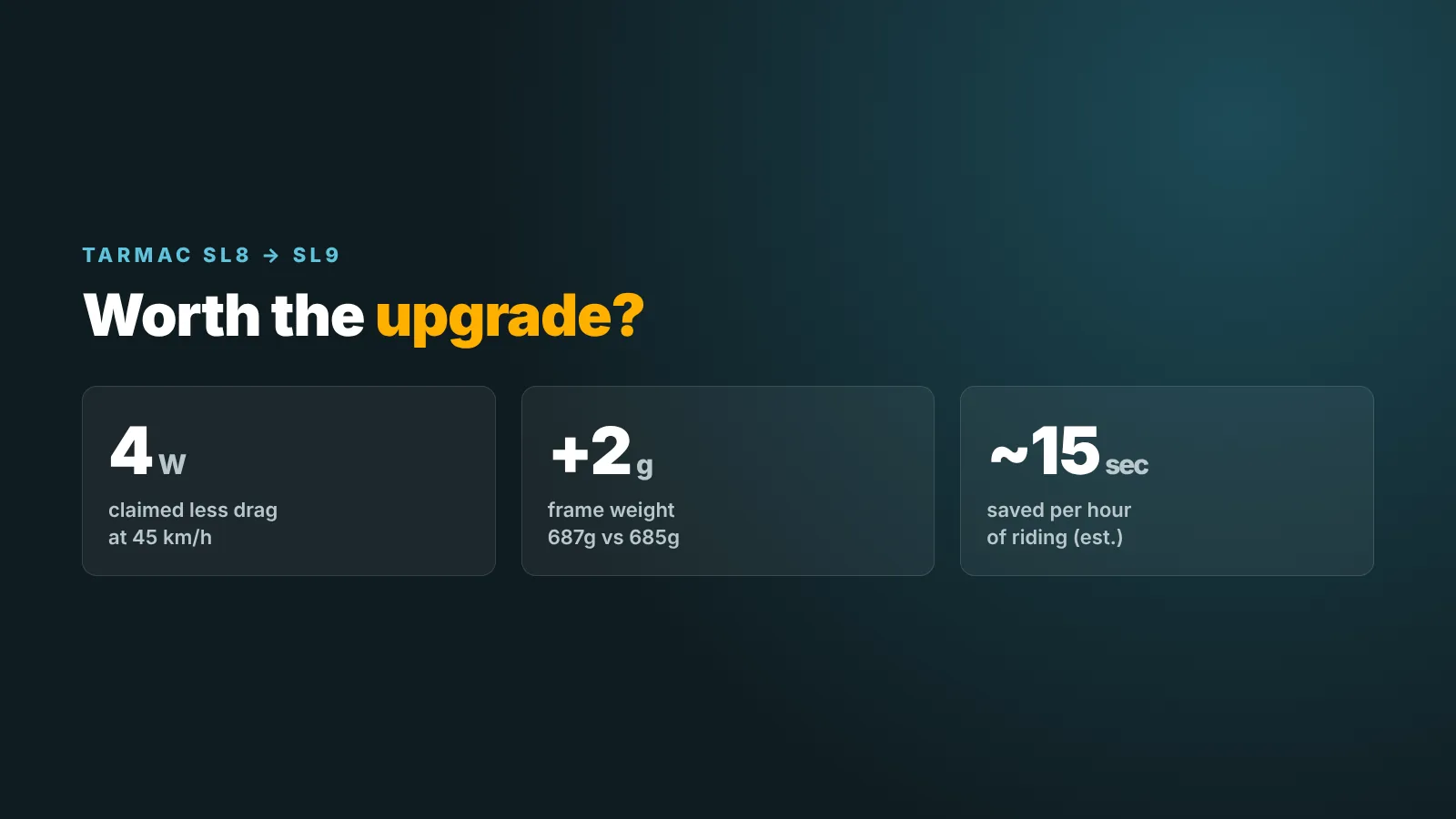 Graphic: Mizubikes
What actually changed
The SL9 is a refinement of the SL8, not a new bike. Here’s what’s different and what isn’t:
| Tarmac SL8 | Tarmac SL9 | |
|---|---|---|
| Frame weight (S-Works, 56cm) | 685g | 687g |
| Aero | Baseline | 4W less drag at 45 km/h (Specialized claim) |
| Head tube | Speed Sniffer | Speed Sniffer, slimmer, about 10% less frontal area |
| Fork | Standard Tarmac fork | Deeper, wider-stance blades |
| Seat tube and post | Straighter seat tube, aero post | Seat tube curves around the rear wheel, slimmer and deeper seatpost |
| Rear dropout | Standard hanger | UDH |
| Steering stop | No | Yes, built into the head tube |
| Bottom bracket | Threaded | Threaded |
| Tire clearance | 32mm | 32mm |
| Geometry | Same | Same, except a toe-overlap fix on the 54 |
The frame is 2 grams heavier. Everything that makes the Tarmac ride like a Tarmac, the geometry, handling and compliance, carried over. First-ride reviews say the SL9 feels the same as the SL8 from the saddle.
What 4 watts is worth in real riding
Specialized measured 4 watts less drag at 45 km/h (28 mph). That’s a racing speed. Most of us ride slower, where the saving in watts gets smaller, but so does the drag you’re fighting.
I ran the numbers with a typical road position (CdA around 0.25). A 4-watt saving at 45 km/h works out to about a 0.45% speed gain at the same power, and that percentage stays roughly the same at 30 or 40 km/h. In time, that’s about 15 seconds per hour of riding. On a three-hour group ride, it’s under a minute.
That’s real, and if you race, a minute matters. If you ride for fitness and fun, you won’t feel it.
The upgrades that do matter
UDH. This is the most practical reason to upgrade. The SL9 has a UDH dropout, and the SL8 doesn’t. SRAM’s newer direct-mount derailleurs, including the 13-speed XPLR road setup I run on my SuperSix Evo, need UDH. If you want to go that direction, the SL9 can and the SL8 can’t.
The steering stop. Because the fork crown sits so close to the down tube, the SL9 has a built-in stop that keeps the bar from swinging far enough to hit the frame. It’s a small thing until your bike falls over.
A narrower bar option. Specialized added a 36cm Rapide cockpit width. If you want a narrower, more aero bar, that’s easier to get on an SL9.
What it costs to upgrade
The cheapest way to upgrade is to swap framesets and move your parts over. The S-Works SL9 frameset is $5,799.99. If you’re on an SL8 with Dura-Ace or Red, your groupset, wheels and cockpit should carry over, so you’re mostly paying the frameset price minus what your SL8 frameset sells for.
That’s where it gets tough. New S-Works SL8 framesets are being discounted hard right now: this morning’s deal scan had a 2025 S-Works SL8 frameset at $3,134.97 at inCycle, 43% off. When new SL8 framesets sell for that, a used one won’t bring much more. So you’re likely looking at $2,500 or more to move from an SL8 to an SL9 frame, for 4 watts and a UDH hanger.
Cheaper ways to get faster on your SL8
If the goal is speed, there’s more to gain for less money:
Tires and pressure. The difference between a slow tire and a fast one is several watts per tire, more than the SL9’s whole aero gain, for under $200. Run them at the right pressure too. My tire pressure guide is written for gravel, but the method is the same.
Wheels. A deeper, modern aero wheelset is one of the biggest aero upgrades you can make to any road bike. It’s also something you’d move to your next bike anyway.
Fit and position. Your body is most of the drag. A narrower bar, a slightly lower front end or a better position on the hoods will save more than 4 watts for most riders. A proper bike fit is money well spent.
Who should upgrade
Upgrade if: you race and want every watt, you want UDH for SRAM’s newer drivetrains, your SL8 is damaged or under a crash replacement, or you can sell your SL8 frameset for close to SL9 money.
Keep your SL8 if: you ride for fitness, group rides or events, and you’re happy with how it rides. You already have one of the best race bikes made, and the SL9 rides the same. Put the money into wheels, tires or a fit.
Buying new and don’t own either? A discounted SL8 is the value pick this winter. With S-Works SL8 framesets this cheap, you get 99% of an SL9 for a lot less. If you’d rather have the newest, see Tarmac SL9 Comp vs Expert vs S-Level vs S-Works or how the SL9 frameset stacks up against the Canyon Aeroad CFR. For more on what changed, see Tarmac SL9 vs SL8.
FAQ
Is the Tarmac SL9 faster than the SL8? Slightly. Specialized claims 4 watts less drag at 45 km/h, about 15 seconds per hour of riding. The frames weigh about the same.
Does the Tarmac SL9 ride differently than the SL8? Not much. The geometry carried over, and first-ride reviews say the SL9 handles and feels like the SL8.
Does the Tarmac SL8 have UDH? No. The SL9 does, which matters if you want SRAM’s newer direct-mount derailleurs.
Should I buy a discounted SL8 or a new SL9? If price matters, the SL8. S-Works SL8 framesets are heavily discounted right now, and the SL9’s gains are small.