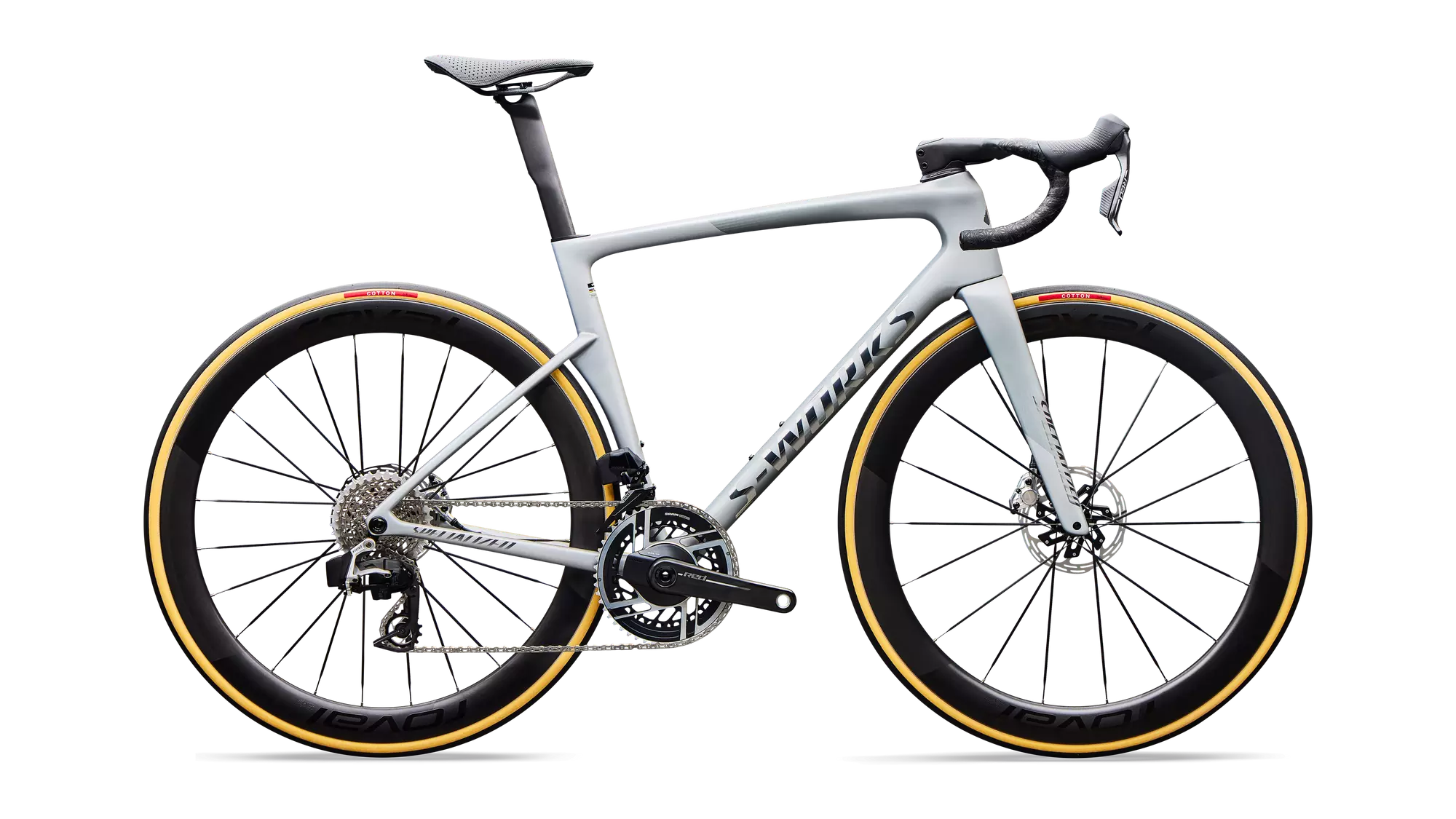
Three weeks ago we walked through the leaked images of a new Tarmac and made the case that Specialized wasn’t about to blow up a proven formula. That call held up. The S-Works Tarmac SL9 is now official, and it’s exactly the kind of update the leaks suggested: real, measurable, and nowhere near as dramatic as the marketing copy wants it to sound.
The headline numbers
Specialized is calling the SL9 the fastest road bike it has ever built, and the case rests on three figures: a claimed frame weight of 687 grams, complete builds as light as 6.5 kg, and a 4-watt aerodynamic saving over the outgoing SL8 at 45 km/h in the wind tunnel. A dedicated Alpinist climbing build reportedly comes in at 6.1 kg. None of that is a leap. The frame is actually 2 grams heavier than the SL8’s, and 4 watts at 45 km/h is a number that matters mostly to WorldTour sprinters and time trial specialists chasing marginal gains, not to the rest of us.
What’s different this time is how Specialized is framing the pitch. Instead of leading with watts or grams, the brand built its launch narrative around something it’s calling “Time to Finish” — a simulation model it says weighs weight, aerodynamics, stiffness, and ride quality together against real WorldTour stages and Monuments, rather than optimizing any single metric in isolation. It’s a reasonable design philosophy, and it’s also a convenient way to justify a bike that isn’t the lightest or most aero thing on the market by insisting those numbers were never the point. Specialized backed the claim with a white paper and simulated comparisons against the Colnago Y1RS, Cervélo S5, and Factor One, all of which unsurprisingly come out behind the SL9 in Specialized’s own model.
What actually changed on the frame
The Speed Sniffer head tube survives, narrowed by 4mm for what Specialized claims is a 10% reduction in frontal area — a smaller, more incremental version of the redesign we flagged as plausible when the side-profile leaks first surfaced in May. The bigger engineering story is the seatpost. Specialized says its moving-leg mannequin testing showed the seat tube and post catch more turbulent airflow off a rider’s legs than previously assumed, so the SL9 gets what they’re calling the thinnest seatpost section they’ve ever produced in that zone. Whether that translates to a real-world difference outside a wind tunnel is a fair question, but the reasoning behind it is more specific and more defensible than the usual “we made it more aero” hand-wave.
Geometry is essentially a carryover from the SL8, with one exception: Specialized nudged toe clearance on the size 54 to fix a fit issue that size apparently had. Tire clearance holds at 32mm, which is conservative next to where some competitors have landed, and the frame finally picks up a UDH derailleur hanger, bringing it in line with where SRAM’s ecosystem has been heading for a while.
Builds, spec, and price
At launch, Specialized is only offering the S-Works tier, in a SRAM Red AXS build and a Shimano Dura-Ace Di2 R9200 build, both priced at £11,999 / €13,999, with the SRAM version running $14,000 in the US and the Shimano version $13,500. Both are available as standard framesets and in WorldTour Team Edition trim. Seven sizes span 44 to 61cm.
Component-wise, this is a bike built almost entirely from Specialized’s and Roval’s own catalog. The Roval Rapide CLX III wheelset carries over from the SL8, still running carbon spokes, but paired here with the new Cotton TLR tires rather than the wheelset’s purpose-built RapidAir TLR rubber — an odd pairing worth watching for real-world rolling resistance and tubeless setup reports once bikes are in reviewers’ hands longer term. Those tires are listed at 30mm but measure closer to 29mm on the Rapide CLX III rim, which keeps them aerodynamically flush with the sidewall. Cockpit is the Roval Rapide one-piece unit, saddle is the S-Works Power EVO, and CeramicSpeed bearings come stock in the headset and bottom bracket at this tier. SRAM builds get a 50/37T chainring and a 10-36T cassette, both narrower-range choices than you’d have seen a Tarmac spec’d with a few years ago.
The part that matters more than the spec sheet
This is Remco Evenepoel’s bike now, and Specialized clearly built the launch story around WorldTour credibility — race-course simulations, Monument comparisons, the whole framing. But the more interesting read is what this launch confirms about how Specialized actually operates. They didn’t chase a clean-sheet aero redesign the way some of their competitors have with their latest platforms, and they didn’t revive the Venge despite years of forum requests for exactly that. They took a bike that was already winning WorldTour sprints against newer, more aggressively aero-optimized competition, and made surgical changes to the parts of it that testing actually justified changing. That’s not the flashiest strategy, but it’s the one that keeps a $14,000 flagship credible to the amateur riders who’ll never see a 4-watt difference but will absolutely notice if the bike doesn’t handle like a Tarmac anymore.
The bigger open question, and one we’ll only get real answers to once independent reviewers put meaningful miles on production bikes, is whether the SL9 is actually as fast as Specialized’s own model says it is, or just fast enough to keep the marketing claim technically defensible. Early first-ride impressions out of the Costa Brava launch camp have already been mixed on that front, with more than one outlet noting the on-road gains feel more marginal than the wind tunnel numbers suggest.
For now, only the S-Works tier exists. Expect the range to extend into Pro and Expert-level builds at lower price points as the SL9 rolls out over the rest of the year — that’s the version most of us will actually end up considering.