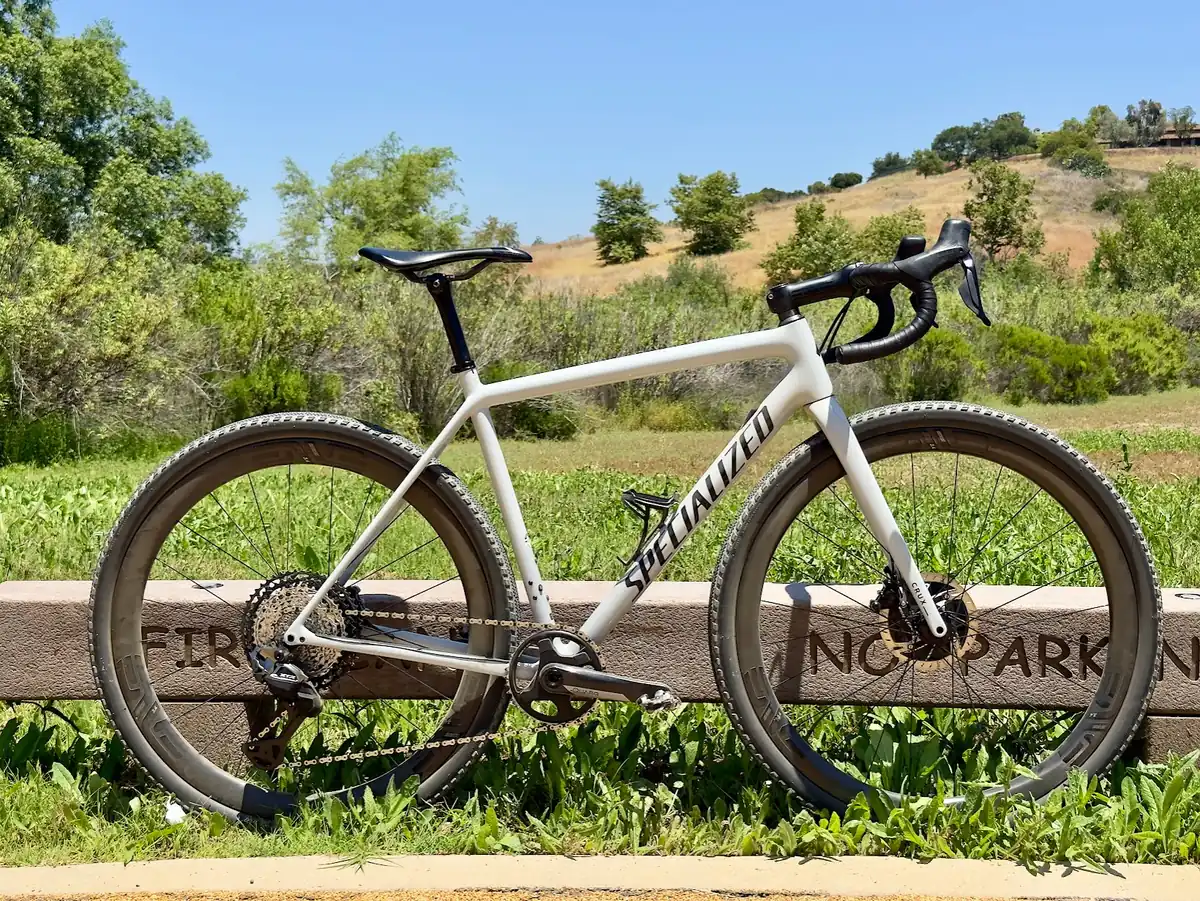
This isn’t the Shimano gravel build you’d get off the shelf. Shimano’s wireless XTR Di2 rear derailleur is a mountain bike part, and 105 Di2 is a road group. On paper they don’t belong on the same bike. In practice the 105 levers pair straight to the XTR derailleur, and the result is a clean 1x Crux with a 10-51 cassette and no cables anywhere in the drivetrain.
Mizubikes may earn a commission from links in this post.
Why a mountain bike drivetrain on a gravel bike
The Crux is a light, fast gravel race frame, and the goal was to keep it simple: one chainring, wireless shifting, and mountain bike low gearing for steep, loose climbs.
A 42T ring with a 10-51 cassette gets you that. The top gear (42x10) is tall enough for fast pavement into the dirt, and the bottom gear (42x51) is a true bailout. For comparison, SRAM’s 13-speed XPLR tops out at a 46T cog, so with the same 42T ring the Shimano setup’s easiest gear is about 11% easier. If you’re weighing the two systems more broadly, I covered that in SRAM 13-Speed vs Shimano GRX 12-Speed for Gravel.
The reason the mix works is that Shimano’s 12-speed Di2 road shifters are wireless, and the new XTR rear derailleur is wireless too, with its own battery. There’s no junction box or wire between them. You pair them in Shimano’s E-Tube app and they talk to each other like a native group. The 105 Di2 levers are also the cheapest way to get Shimano’s hydraulic Di2 hoods, which keeps the cost of the experiment down.
The full build
| Part | What I used |
|---|---|
| Frame | Specialized Crux frameset (bought used) |
| Rear derailleur | Shimano XTR Di2 wireless, 12-speed, SGS long cage |
| Shifters / levers | Shimano 105 Di2 12-speed, left and right |
| Cassette | Shimano XT CS-M8200, 12-speed, 10-51T |
| Crankset | Shimano GRX RX820 1x, 42T |
| Chain | Shimano 12-speed |
| Rotors | Shimano CenterLock |
| Wheels | ENVE SES 3.4 (hookless), with a Micro Spline freehub body |
| Tires | Maxxis Reaver 45c |
| Stem | ENVE carbon road, 120mm |
| Handlebar | Zipp Service Course SL-70 XPLR, 40cm |
| Weight | 17 lbs 13 oz (about 8.1 kg) |
A few of these choices are forced by the drivetrain. The XT cassette is a Micro Spline cassette, so the rear wheel needs a Micro Spline freehub body rather than the HG road body most gravel wheels ship with. And the 10-51 cassette needs the long-cage (SGS) version of the XTR derailleur. The medium-cage version is for Shimano’s 9-45 cassette.
Build notes
Most of this build is a normal gravel bike build: tubeless tires, rotors and cassette, brake hoses, fork and headset, then cockpit and bleed. The parts worth calling out:
Tires and hookless rims. The ENVE SES 3.4 is a hookless rim, so check that your tire is on the rim maker’s approved list and stay under its pressure limit. In the video, the tubeless tires go on first, before the rest of the build.
Brakes. The 105 Di2 levers are hydraulic, so you’re cutting hoses to length, installing barbs and inserts, and bleeding both brakes. A proper Shimano bleed kit makes this far less messy. The front brake also needed a rotor adapter fix before the caliper lined up correctly, which I show in the video.
Pairing the XTR derailleur to the 105 shifters. This is the step people ask about. Pairing is done through E-Tube, the same as pairing any Shimano wireless component, and once it’s done the 105 levers shift the XTR derailleur exactly as they’d shift a road derailleur. The video walks through it at 13:19.
Chain length. Size the chain the way Shimano specifies for the XTR derailleur with a 51T cog, not the way you would for a road derailleur. The big cog is what sets the length.
How it came out
At 17 lbs 13 oz with a mountain bike cassette, 45c tires and an alloy bar, this is a light gravel bike, and there’s still easy weight to drop with a carbon bar. The bigger win is the setup itself: one ring, fully wireless shifting, and a low gear that actually saves you on steep dirt. My first ride impressions are in the last chapter of the video, and I’ll follow up with a long-term review.
If you want to run something like this, check two things first. Your frame needs to fit the tires you want. This Crux is the generation I tested for real-world tire clearance. And if you’d rather go SRAM, your frame needs a UDH dropout for 13-speed XPLR, which I explain in Will SRAM 1x13 XPLR Fit Your Gravel Bike?. For a different take on mountain bike gearing on drop bars, here’s my Scalpel HT gravel conversion with Garbaruk’s 10-52.