If you’re shopping for your first gravel bike and trying to make sense of tire clearance specs, here’s the first thing to understand: the number on the spec sheet isn’t the full story.
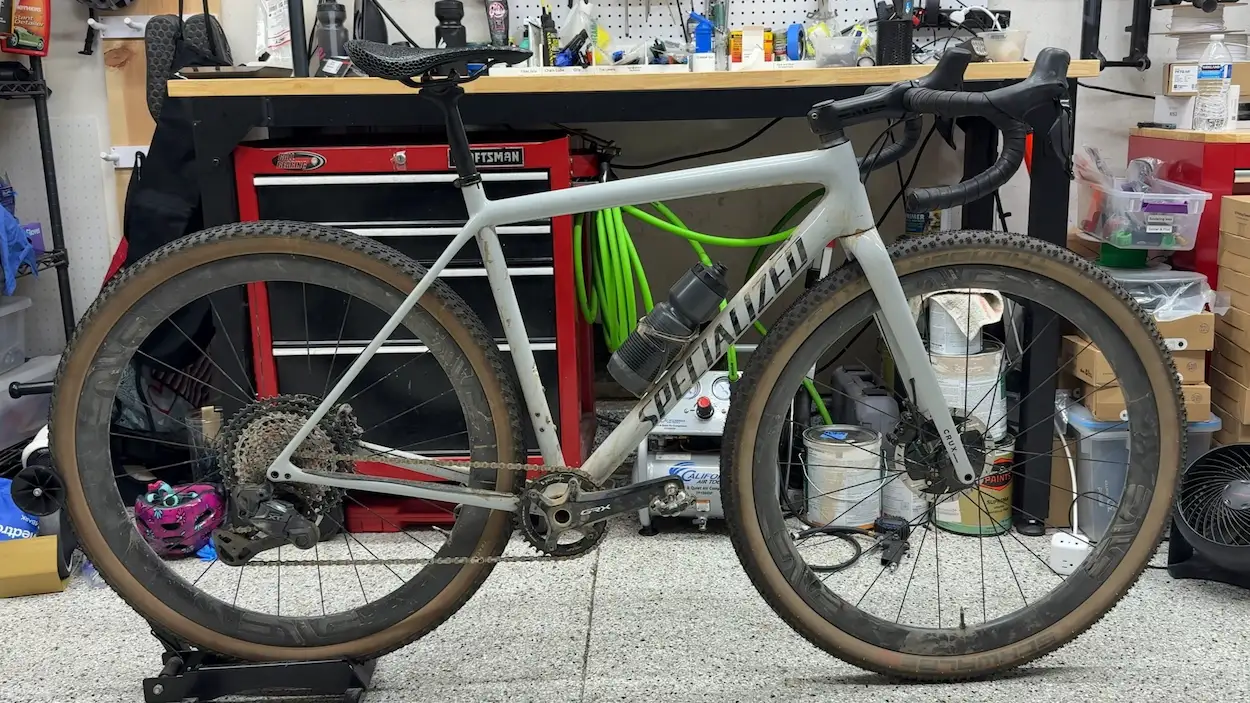
I recently tested this on the Specialized Crux. The stated max clearance is 47mm — but I mounted a 50c tire in the rear and a 2.1" up front to see what the frame could actually handle. Watch the full video here.
Here’s what I found, and what it means if you’re still figuring out how much clearance you actually need.
Why Manufacturer Specs Are Intentionally Conservative
Bike brands have to account for a lot of variables: different rim widths, different tire tolerances, and riding conditions — particularly mud, which demands much more clearance than dry hardpack. So when Specialized says 47mm, that number is designed to work reliably across the range of rims and tires a typical buyer might run, in worst-case conditions.
In practice, there’s usually more room than the spec suggests.
Real-World Clearance on the Specialized Crux
The Crux frame (2022–2026) has the same stated 47mm / 650b x 2.1" clearance across all model years. I was running an ENVE SES 3.4 wheelset with a 25mm internal width — and that matters. Wider rims push tires outward, so a 50c tire on a wide rim measures wider than its nominal size.
Results with that setup:
- Rear (Specialized Tracer TLR 50c): Fit, but clearance was tight. Fine for dry conditions, not something I’d push in mud.
- Front (Schwalbe Thunder Burt 2.1): Noticeably more room. The fork is more forgiving than the rear triangle.

Despite the different nominal sizes, front and rear ended up with roughly similar actual clearance — the wider rear tire balanced out by the tighter frame geometry, while the larger front tire had more fork room to work with. For dry gravel and mixed terrain, the setup worked well without changing the character of the bike.
How the Crux Compares: Gravel Bike Tire Clearance Chart
Tire clearance varies more across popular gravel bikes than most people expect. Here’s how the current field stacks up:
| Bike | Max Clearance (700c) | Max Clearance (650b) | Focus |
|---|---|---|---|
| Canyon Grail | 42mm rear / 46mm front | — | Gravel race |
| Specialized Crux | 47mm | 2.1" | Lightweight race |
| Trek Checkpoint SL Gen 3 | 50mm | — | Adventure / all-round |
| Specialized Diverge 4 | 55mm | 2.2" | Comfort / all-road |
| Argon 18 Dark Matter | 57mm | — | Adventure / all-round |
| Allied Able (Gen 2) | 57mm | — | Lightweight race |
| Lauf Seigla | 57mm | 2.25" | Race + suspension |
| Ari Shafer 3.0 | 58mm | 2.25" | Versatile / adventure |
A few notes on each:
Canyon Grail — The asymmetric clearance reflects its race-first design. Canyon deliberately separates the Grail from their adventure-focused Grizl, which goes up to 50mm. If you plan to run 45mm+ tires regularly, check fit carefully.
Specialized Crux — Still one of the more generous clearances in the pure race category, and the 650b option is real if you want more volume without going to a different frame. It’s worth noting the current generation is getting long in the tooth — more on that below.
Trek Checkpoint SL Gen 3 — Bumped from 40mm to 50mm in the latest generation. More adventure-oriented than the Crux, but the extra clearance gives it genuine versatility.
Specialized Diverge 4 — The benchmark among big-brand bikes. It debuted at Unbound 2025 with sponsored riders openly racing it pre-announcement, and 55mm is the most of any mainstream performance gravel bike right now. It’s heavier and more comfort-focused than the Crux — different philosophy — but the clearance gap is real.
Argon 18 Dark Matter — A Canadian brand that doesn’t get enough attention in the US. The Dark Matter pairs 57mm clearance with adventure-capable geometry and a generous spec for the price. Recent reviews have called it a top all-rounder, particularly on rough and technical terrain.
Allied Able (Gen 2) — A complete ground-up redesign for 2025. The new Able dropped 300g from the frame, ditched the quirky elevated driveside chainstay of the original, and jumped from 43mm to 57mm clearance. It’s a legitimate race bike that can run proper MTB tires — reviewers have fit a 2.4" Vittoria Terreno up front with room to spare. Made in the USA originally; now manufactured overseas, which has been a talking point among fans of the brand.
Lauf Seigla — The Icelandic brand’s calling card is their Grit SL leaf-spring fork, which offers 30mm of undamped travel at roughly 400g less than a traditional air fork. The frame itself hits 57mm clearance with tight 425mm chainstays — same race geometry as their older True Grit. It’s 1x only and requires a wider 73mm bottom bracket shell, but for riders who want suspension without the weight penalty, there’s nothing else quite like it.
Ari Shafer 3.0 — A Utah-based direct-to-consumer brand that’s punching well above its price point. The Shafer 3.0 hits 58mm clearance, comes in under 930g for the frame, and is suspension-fork compatible with up to 60mm of travel. The range starts under $3,000 for a complete bike, which makes it one of the best value propositions in the big-clearance gravel category.
What to Know Before You Buy
Think about where you’re riding. For dry gravel and mixed pavement, 40–45mm of actual tire covers most riding. Rougher or wetter terrain is where more clearance earns its keep — both for tire volume and the mud gap it creates.
Rim width affects actual tire width. The same tire measures differently on different rims. Always test fit with your actual wheels, not just the tire spec.
Front and rear clearance are usually different. Forks almost always have more room than the rear triangle — which is why running a larger front tire than rear, like I did on the Crux, often works.
The spec is the floor, not the ceiling. There’s typically some buffer built in. How much depends on the frame. Test carefully with your specific tire and rim combination before committing.
Will Specialized Release a New Crux in 2026?
The current Crux launched in late 2021 and has had one meaningful update since — a UDH dropout addition — leaving it otherwise unchanged for going on five years. With the Diverge 4 now at 55mm and most competitors pushing 50mm+, the pressure to update is real.
The cycling press is expecting something. Road.cc recently called the current Crux overdue for a redesign, pointing to aero tube profiles, an integrated cockpit, and more tire clearance as the likely asks. Forum chatter on Escape Collective and Weight Weenies has been converging around a new generation — possibly landing as a 2027 model — with cockpit integration and meaningfully larger clearance. Nothing is confirmed, and an earlier rumored Q1 2026 window came and went without an announcement.
For now, the current Crux is still a genuinely capable race bike. But if you’re on the fence, it’s worth knowing an update is likely on the horizon.
Full tire fit details and real-world clearance shots are in the video. Watch here.