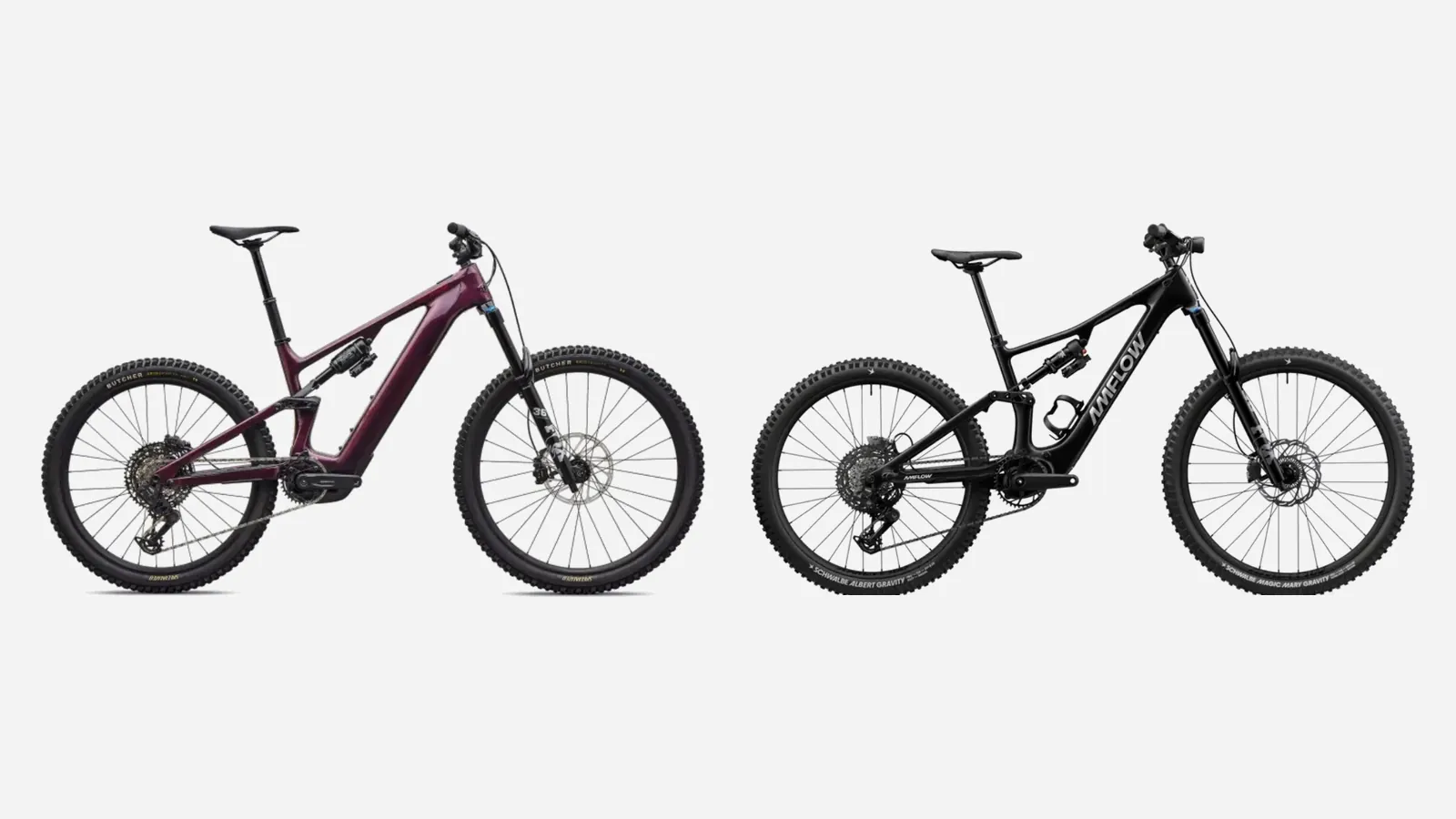
Quick answer: In the Specialized Turbo Levo 4 vs Amflow PX Carbon matchup, the Amflow wins on weight, climbing power, and how much bike you get for the money. The Levo 4 wins on battery size, a removable pack, and having a real dealer network behind it. If you ride steep, technical terrain and are comfortable buying direct, pick the PX. If you want a big-battery, low-drama trail bike you can get serviced locally, pick the Levo.
The closest like-for-like pairing is the Levo 4 Comp Carbon against the base PX Carbon. Both have a carbon frame, a mullet wheel setup, 150mm of rear travel, a 160mm fork, and SRAM’s S1000 Transmission. This post compares those two. The Pro and S-Works trims are a different conversation. If you want the full Specialized range first, I covered it in the Turbo Levo 4 lineup guide.
Specialized Turbo Levo 4 vs Amflow PX Carbon: the numbers
| Specialized Turbo Levo 4 Comp Carbon | Amflow PX Carbon | |
|---|---|---|
| US price | $7,999.99 list; Specialized’s US page currently shows a $5,999.99 sale price | $7,999 |
| Motor | Specialized 3.1 (Brose-built), 105 Nm, 810 W | Avinox M2S, 130 Nm nominal, 150 Nm boost, 1,500 W peak |
| Battery | 840 Wh, removable | 700 Wh, integrated (not removable) |
| Travel | 160mm fork / 150mm rear | 160mm fork / 150mm rear |
| Fork and shock | Fox 36 Rhythm, Float X Performance | Fox 36 Performance, Float X Performance |
| Drivetrain | SRAM S1000 Eagle Transmission | SRAM S1000 Eagle Transmission |
| Weight | 24.41 kg (53 lb 13 oz), size S4 | 20.6 kg claimed |
| Frame warranty | Not verified | 5 years; motor and battery 2 years |
Sources for the table are the Specialized US and Amflow US product pages and the Pinkbike launch coverage listed below. The Amflow weight is the brand’s own claim. Independent testers weighed the pricier Pro at roughly 21.3 to 21.4 kg. The base bike has alloy wheels instead of carbon, so I’d expect it to land a bit heavier than the Pro. Even so, you’re looking at roughly 3 kg less than the Levo.
One caveat on Specialized’s motor figures. Launch-era reviews quoted 101 Nm and 666 W for the standard 3.1 motor. Specialized’s current US listing for the 2026 Comp Carbon says 105 Nm and 810 W. I used the brand’s current numbers, but you may see both in older reviews.
Motor and climbing: the Amflow isn’t close
On paper this is a mismatch. Avinox lists 150 Nm in Boost mode (per Amflow’s US page), and the M2S peaks at 1,500 W. The Boost mode lasts 60 seconds, so that’s a burst figure, not something you’ll hold up a 40-minute grind. Even so, the Levo’s 810 W is a long way behind.
The reviews back it up. Velomotion called the M2S the benchmark mid-drive on the market. OutdoorGearLab said that climbing back-to-back with a Levo made the Levo feel like a skid steer. That Levo is probably not the current Levo 4, so treat the comparison as directional. BikeRadar said the PX turns its output into real climbing control instead of just raw shove.
There’s a flip side. One reviewer noted that the PX can be too much for newer riders. If you’re coming from a regular mountain bike and want a gentle ramp-up, the Levo’s softer delivery is a plus. For an experienced rider who wants to clean awkward, steep, technical climbs, the Avinox is the stronger tool. I wrote more about how the motor stacks up against its predecessor in Avinox M2S vs M1.
Battery and range: the Levo’s real advantage
The Levo 4 ships with an 840 Wh pack you can take out of the frame. Specialized also sells a 280 Wh range extender that brings the total to 1,120 Wh, and a lighter 600 Wh battery for shorter rides. That’s a very flexible setup. You can charge the pack indoors, swap in a spare, or go big for an all-day ride.
The PX uses a 700 Wh integrated battery. That lets Amflow build a very slim downtube and keep the bike light. The cost is flexibility. You can’t pull the pack, and one review database flagged the smaller pack as a weak spot in range testing. Amflow does sell an external RS600 600 Wh range extender as an option.
Charging differs too. The Levo 4 Comp comes with a 4-amp charger. The PX Carbon Pro ships with a 12A, 508 W Avinox charger. If you’re topping up between laps or after a short ride, the Amflow side is much quicker.
Handling, geometry, and weight
The weight gap is the main thing you’ll feel on the trail. Testers repeatedly describe the PX as light-footed and easy to flick around, with BikeRadar saying it feels playful compared with heavier enduro bikes. The Levo’s 840 Wh battery is a big reason it’s one of the heavier bikes in its class. Blister’s review made that same point.
The PX isn’t flawless downhill. BikeRadar’s headline noted that repeated rough descents expose its limitations. OutdoorGearLab’s review, as summarized by 99spokes, called out more feedback and less composure than rivals on rough terrain. A heavier Levo with a bigger fork stanchion budget at the top of the range is likely to feel calmer when things get steep and chattery. That is inference from the weights and reviewer comments, not something I’ve measured.
Both bikes have adjustable geometry. The PX takes it much further, with five head-angle settings, two bottom bracket heights, and four chainstay lengths. That works out to up to 40 combinations. The Levo has adjustable chainstay, head angle, and bottom bracket as well, and adds SWAT storage in the downtube. For a rider who carries tools and a tube, that storage is genuinely handy.
Price, warranty, and service
At list price, the two cost the same: $7,999.99 for the Levo 4 Comp Carbon and $7,999 for the PX Carbon. Specialized’s US page currently shows the Comp Carbon on sale at $5,999.99. Specialized also cut US Levo prices in May 2026, though reporting says the Comp Carbon was excluded from that cut. If that sale price is available when you shop, the Levo becomes the better value, because it’s $2,000 cheaper for a bike with a bigger battery. If you need to stretch to a base Levo, the Levo 4 Alloy is listed at $4,999.99 on Specialized’s US site.
Amflow gives a 5-year frame warranty to the original owner. A second owner gets a limited 2 years. The motor and battery are covered for 2 years, with the battery also capped at 500 charge cycles. Reviewers have also flagged a thin dealer network and some criticism of service and backup. That’s the real tradeoff of buying direct from a newer brand. A Specialized dealer can handle a motor or battery problem in person. With Amflow, you’ll likely be dealing with the brand or a smaller set of retailers.
If you’re choosing between several Avinox bikes, my best Avinox eMTBs of 2026 list covers cheaper options.
Which one to pick
Buy the Amflow PX Carbon if you ride steep, technical terrain, care about weight, and are comfortable with direct-to-consumer service. It’s also the one to buy if you want the most powerful motor on the market and don’t mind a non-removable battery.
Buy the Turbo Levo 4 if you want a big removable battery, downtube storage, and a dealer you can walk into. It’s also the better pick if the $5,999.99 sale price is live, or if you want a calmer, heavier ride on rough descents. For most riders on mellower terrain, the Levo is the lower-stress choice.
FAQ
Is the Amflow PX Carbon lighter than the Levo 4? Yes. Amflow claims 20.6 kg for the PX, and testers measured the Pro at around 21.3 to 21.4 kg. Specialized lists the Levo 4 Comp Carbon at 24.41 kg in size S4.
Does the Amflow PX Carbon have a removable battery? No. Its 700 Wh battery is integrated, although Amflow sells an external 600 Wh range extender. The Levo 4’s 840 Wh battery is removable.
Is the PX Carbon Pro worth the extra money over the base PX Carbon? BikeRadar’s take is that the cheaper model is better value for many riders. The Pro adds weight savings, better suspension adjustment, and higher-end parts, but doesn’t change the ride in a fundamental way.