Mizubikes may earn a commission from links in this post.
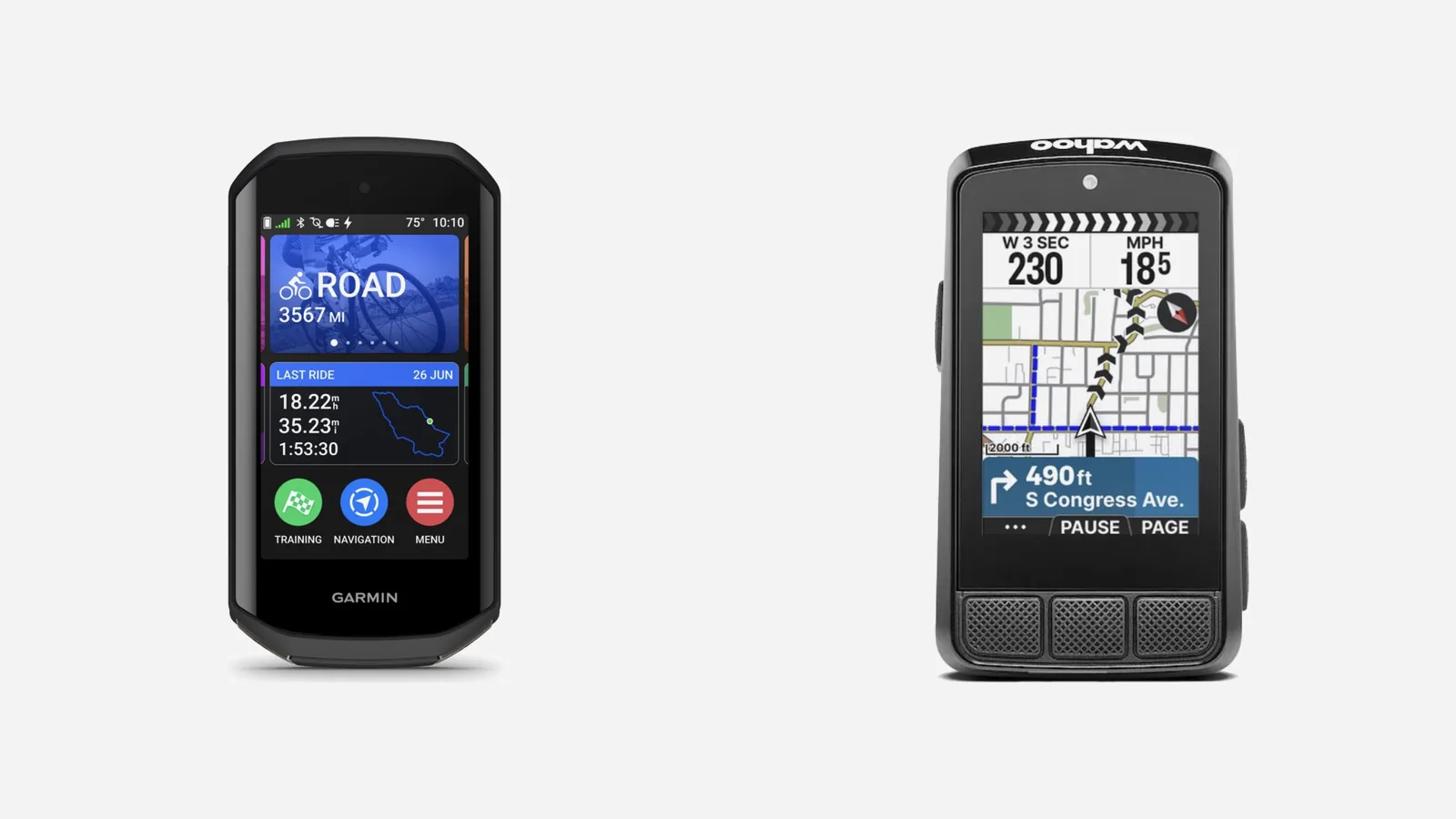
Quick answer: For gravel, most riders will be happier with the Wahoo Elemnt Roam 3. It is smaller, easier to set up, and roughly $290 cheaper at current sale prices. Choose the Garmin Edge 1050 if you want the biggest, brightest map screen and deep training data, and you don’t mind charging nightly.
This Garmin Edge 1050 vs Wahoo Elemnt Roam for gravel question has a wrinkle. “Roam” now means the third-generation Roam 3, which replaced the earlier ROAM in May 2025. The Edge 1050 is also on its way out. Garmin has launched the Edge 1060, and the 1050 is on Black Friday sale. Details on both below.
Price: the gap is bigger than the spec sheet gap
The Garmin Edge 1050 lists at $699.99. Amazon has it at $599.98 right now, and DC Rainmaker’s deal roundup shows the same $100 discount, with the 1050 still getting most of the new software features from the 1060. That last point matters. Buying the outgoing model isn’t buying a dead end.
The Wahoo Elemnt Roam 3 lists at $464.99 on Wahoo’s US store. One recent roundup found it on Amazon for $309.31. Sale prices move daily, so check before you buy. If you’re shopping this weekend, our Black Friday bike deals post tracks what’s live.
Head-to-head specs
| Garmin Edge 1050 | Wahoo Elemnt Roam 3 | |
|---|---|---|
| List price (US) | $699.99 | $464.99 |
| Screen | 3.5" touchscreen, 480x800 | 2.8" touchscreen, 320x480, plus buttons |
| Weight | 161 g | about 109 g |
| Claimed battery | 20 hrs (60 hrs battery saver) | Up to 25 hrs |
| Ecosystem | Garmin Connect, Connect IQ apps | Wahoo app, syncs with Komoot, RideWithGPS, Strava |
The screen, weight, price and battery figures come from a 2026 lineup comparison. The Roam 3’s physical buttons are worth noting: it has a touchscreen and six physical buttons.
Navigation on gravel routes
Both units do offline maps and turn-by-turn, and for pre-planned gravel routes that’s most of the job. The Roam 3 is easy to feed. Routes from Strava, RideWithGPS and Komoot pull into the Wahoo app and sync to the head unit. If you’re riding a route you built on a laptop, that’s about as painless as it gets.
The Roam 3 also handles on-the-fly routing with a gravel-friendly option. You can pick paved, mixed or unpaved as your surface preference for a new route. One bikepacking reviewer did call the maps still pretty basic, wishing for topo lines when zoomed in.
The Edge 1050 is the stronger choice for improvising. One 2026 comparison says it supports on-device course creation, ride-specific routing, map management and points of interest. Another source says Wahoo’s maps are simpler than Garmin’s, and that for exploratory riding in new areas, Garmin wins. ClimbPro also carries over to gravel. That’s useful when a fire road kicks up and you want to know how long it lasts.
Battery: don’t trust either claim
Garmin rates the 1050 at 20 hours in demanding use, up to 60 in battery saver. Wahoo claims up to 25 for the Roam 3. Real-world reports vary widely.
On the Garmin side, one reviewer often saw just under 30 hours per charge, while another reviewer’s testing found around 15 hours. On the Wahoo side, Bikepacking.com never reached 25 hours in its testing and found sensors, especially a radar, were the bigger drain. Another reviewer measured the Roam 3 at 28 hours.
The practical read: both will cover a long gravel day, and both can come up short on a big bikepacking weekend without a power bank. The Garmin gives you more control to stretch it. One group test noted that its power-saving options let you tune everything from screen timeout to GPS mode. The Wahoo is simpler, with fewer knobs. For a full-day gravel ride, I’d call it a wash. For multi-day trips, Garmin’s battery-saver mode is the better safety net.
Screen and size on a gravel cockpit
The 1050’s display is its best argument. One reviewer calls it probably the best of the current crop. On rough gravel, a big, bright screen is easier to read when everything is vibrating.
The tradeoff is bulk. At 161 g, it needs a sturdy out-front mount, and it takes up real room on a drop-bar cockpit already crowded with a bag, lights and a camera. The Roam 3 is about 50 g lighter. It’s not tiny, though: Road.cc noted it has a thicker profile than most units, and that its touch screen occasionally responds to excess water. That matters on muddy or wet gravel days. The physical buttons give you a fallback.
Accuracy and the ecosystem
One reviewer found the Roam 3 a bit disappointing on accuracy compared with Garmin Edge units with multi-band GNSS. Another test over wooded land and riverside paths had both Roam and Edge doing the best job. Under tree cover, which gravel routes love, the difference is small.
On ecosystem, the5krunner puts it this way: the real positive differentiator for Garmin remains its Connect IQ app store. If you already wear a Garmin watch and want everything in one place, that tips things toward the Edge. If you use a Wahoo trainer, the Wahoo ecosystem is a natural fit.
Which one to buy
Buy the Roam 3 if you mostly follow routes from Komoot, RideWithGPS or Strava, want quick phone-based setup and want to keep $250-plus in your pocket. That money buys a set of gravel tires instead.
Buy the Edge 1050 if the screen size matters to you, you want training analytics and Garmin Connect, or you often build routes on the fly. At about $600 it’s easier to justify than at $700. Neither unit is a bad choice. Just don’t pay full list for the Garmin when its replacement is out and the sale is live.
If you’re still building the bike around the computer, our gravel bike buying guide covers the rest of the decisions.
FAQ
Is the Edge 1050 still worth buying now that the Edge 1060 exists? Cyclingnews says it is arguably still worth buying over the more expensive 1060, and it’s now on sale. DC Rainmaker notes it’s getting most of the new software features.
Does the Wahoo Roam 3 have a touchscreen? Yes. The Roam 3 has a 2.8-inch colour touchscreen with physical buttons. Older write-ups that describe the Roam as button-only are talking about the previous generation.
Which has the longer battery life, the Edge 1050 or Roam 3? On claims, the Roam 3 leads in standard use (25 hours vs 20). The Garmin pulls ahead with a 60-hour battery-saver mode. Real-world results vary by settings and sensors.