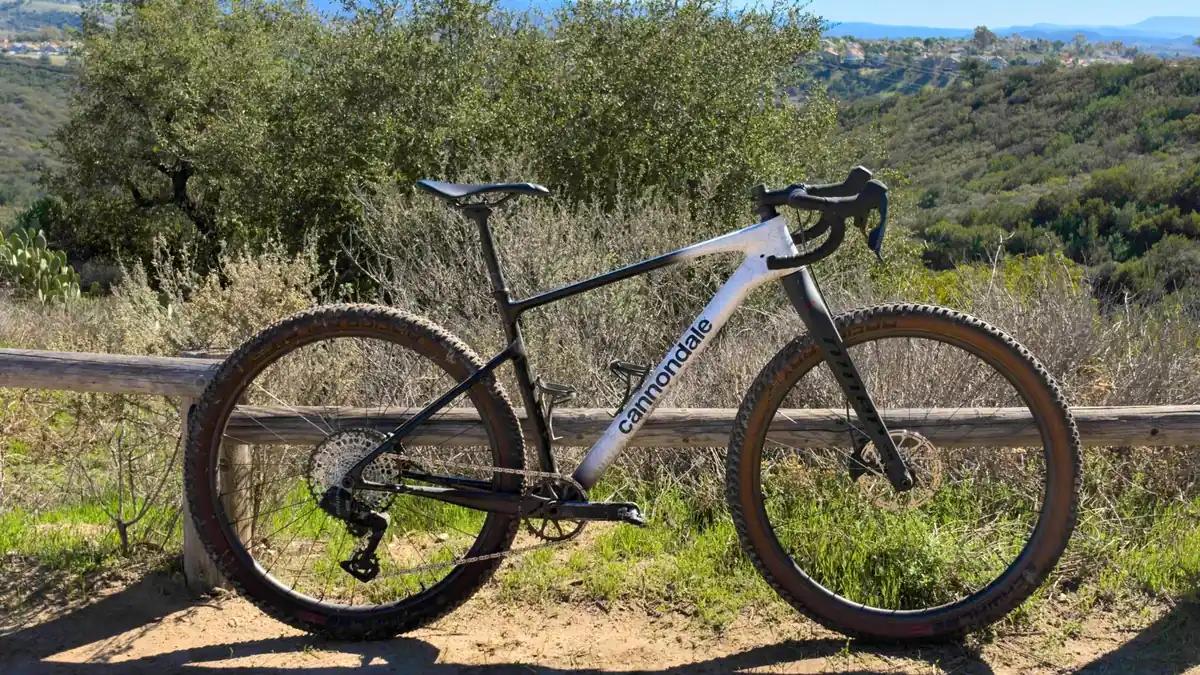
When I built up my Cannondale Scalpel HT as a drop bar gravel bike, I left it on a pair of 2.25" Thunder Burts. That made sense for a first pass. They roll fast, they’re light, and they kept the bike feeling like a gravel bike that happened to have a mountain bike frame under it. But the whole point of starting with an XC hardtail was the tire clearance, and I wasn’t using it. So I swapped to a Schwalbe Racing Ray up front and a Racing Ralph in the back, both 29 x 2.35, and took it out on the trails I normally ride.
If you missed the build, the full breakdown of the frame, the Garbaruk 10-52 cassette, and how the drivetrain went together is in the MTB to gravel conversion post, and the build video is here:
The setup
For anyone landing here without the backstory: this is a Cannondale Scalpel HT Hi-Mod hardtail running a rigid Niner RDO Boost fork in place of the suspension fork. Shifting is SRAM Rival XPLR AXS with drop bar levers, paired with a Garbaruk 10-52 cassette so the bike still has real climbing gears off-road. Wheels are BTLOS carbon rims with a 30 mm internal width, laced to DT Swiss 350 hubs.
The tires are the Schwalbe Racing Ray 29 x 2.35 on the front and the Schwalbe Racing Ralph 29 x 2.35 on the rear, both in the Super Race casing with the transparent sidewall. That front/rear pairing is a classic XC combo. The Ray has a more open, aggressive tread for steering and braking grip, and the Ralph is a bit tighter and faster rolling for the rear.
I ran them at 24 psi front and 26 psi rear. That’s roughly where I’d run tires like this on rougher trails anyway, and honestly I think I could have gone a few psi lower, especially with the rigid fork.
How much bigger is a 2.35 really?
Less than you’d think. Schwalbe’s own sizing lists the 2.25 at 57-622 and the 2.35 at 60-622, so on paper you’re only gaining about 3 mm of width.
| Tire size | ETRTO | Nominal width |
|---|---|---|
| 29 x 2.25 | 57-622 | ~57 mm |
| 29 x 2.35 | 60-622 | ~60 mm |
That matters for how you read the rest of this. A lot of what I noticed on the trail comes from the tread pattern, not just the extra volume. The Thunder Burts are a low-profile, fast-rolling tire. The Racing Ray and Racing Ralph have much taller, more aggressive knobs. So when I say the bike felt more capable, don’t credit all of it to 3 mm of width.
Clearance
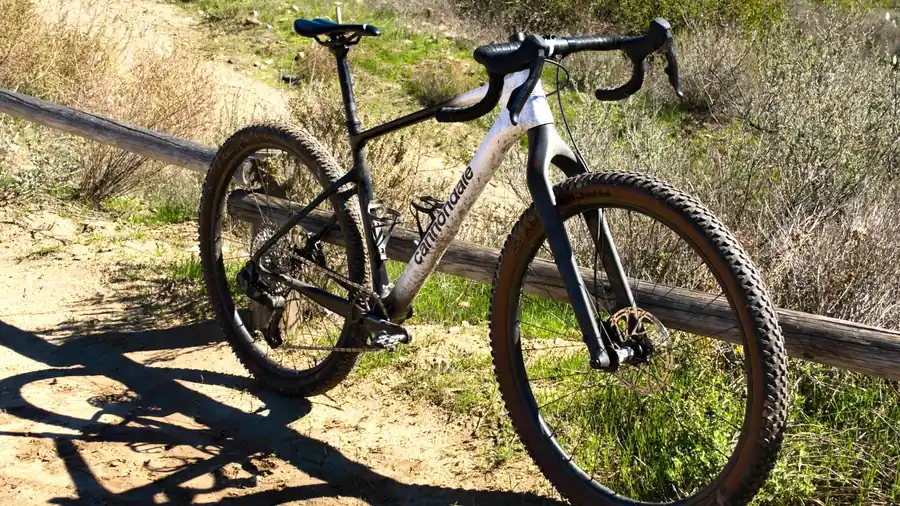
In the rear there’s still room left over, and my guess is a 2.4 would fit. I haven’t tested that yet, so take it as a guess. Up front there’s a lot more space, which isn’t surprising with a fork designed around mountain bike tires. That lines up with Flow Mountain Bike’s review of the Scalpel HT, which noted the frame was designed to take tires up to 2.4".
What got better
Grip was the first thing I noticed. The bike holds a line in corners far better than it did on the Thunder Burts, and that translated straight into confidence. I was leaning it over in places where I’d have backed off before.
Chunky sections were noticeably smoother. With a rigid fork, the front tire is basically your suspension, so more air volume and a more supple casing up front pays off right away. Steeper trails felt more comfortable too, and braking was more controlled. On loose descents the front tire bites instead of skating, and that alone makes the bike a lot less nervous.
It also felt really stable on fast, open trails. Point it down a wide fire road and it just tracks.
What it costs, and what it doesn’t fix
The Thunder Burts felt faster on the road. I didn’t time anything, so this is purely a feel thing, but it makes sense. Lower knobs roll faster on pavement and hardpack, and the Racing Ray and Ralph give some of that back in exchange for grip.
Bigger tires also don’t turn a rigid bike into a suspension bike. Bumps are still very noticeable on downhills, and on genuinely rough trails it’s just not as fun as a bike with a suspension fork. The tires take the edge off. They don’t erase it.
The other thing I noticed is that the front end felt a little slow when changing lines or making sharp turns. I’m honestly not sure how much of that is the bike’s geometry and how much is the bigger, heavier front tire. It’s not a deal breaker, but it’s there.
Verdict
This bike lives right where gravel and mountain bikes blur together. The drop bars make it feel faster on the road than a mountain bike, and the 2.35 tires make it way more capable off-road than a typical gravel bike.
But it’s nowhere near a full suspension bike, or even a hardtail with a suspension fork. If I’m heading out to ride rough singletrack, I’m grabbing one of those. If I’m doing a long gravel ride with a lot of road miles, I’d lean toward a traditional gravel bike. This one ends up somewhere in the middle, and it doesn’t replace either.
What it does do well is the in-between ride: the loop that’s half pavement and fire road and half real trail, where a gravel bike is overmatched and a mountain bike feels like a slog getting there. For that, 2.35s on a drop bar hardtail make a lot of sense. If you’re building something similar and your frame has the clearance, I’d go big on the tires. Just don’t expect them to do the job of a suspension fork.
Some links in this post are affiliate links. If you buy through them, Mizubikes may earn a small commission at no extra cost to you. Garbaruk provided the cassette and chainring for this build at a discount, as disclosed in the build post.