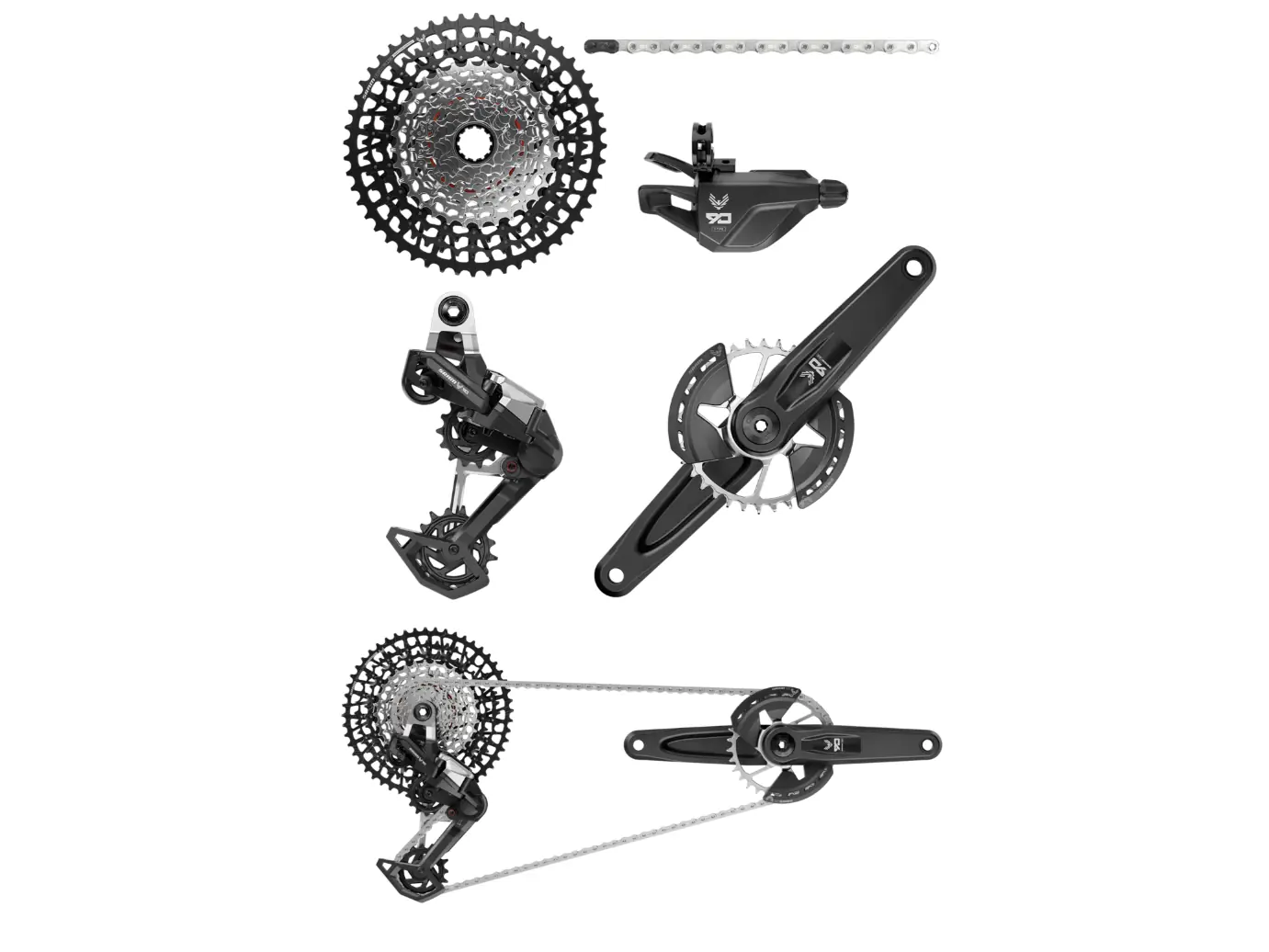
If you’re shopping for a new mechanical mountain bike drivetrain, you’ve likely come across SRAM Eagle 70 and Eagle 90. They’re SRAM’s mechanical versions of its Transmission groupsets, and they bring that hangerless, frame-mounted shifting to a much more accessible price. But how do they compare to Shimano’s popular SLX, XT and XTR?
In this post, I break down the major contenders by weight, MSRP and overall value: SRAM SX, GX, X01, Eagle 70 and Eagle 90, and Shimano SLX, XT and XTR.
SRAM Eagle 70 vs Shimano XT: XT M8100 is about 550g lighter (1,743g vs 2,290g) for about $130 more ($621 vs $490 MSRP), and it fits any frame with a derailleur hanger. Eagle 70 is the cheaper, tougher hangerless option, but only if your frame is UDH.
Quick answer: Shimano SLX M7100 is still the best value: it’s lighter than Eagle 70 and costs less. Eagle 90 is the pick if your frame is UDH and you want Transmission-style shifting without paying for AXS. XT M8100 is the sweet spot for mechanical weight savings. The only reason to buy XTR M9100 is if you’re chasing grams.
Mizubikes may earn a commission from links in this post.
Drivetrain Comparison Table: Weight and MSRP
| Groupset | Type | Weight (g) | MSRP (USD) |
|---|---|---|---|
| Shimano SLX M7100 | Mechanical | 1,857 | $396 |
| SRAM SX Eagle | Mechanical | 2,049 | $404 |
| SRAM Eagle 70 Transmission | Mechanical, Full Mount | 2,290 | $490 |
| SRAM GX Eagle (previous gen) | Mechanical | 1,727 | $587 |
| Shimano XT M8100 | Mechanical | 1,743 | $621 |
| SRAM Eagle 90 Transmission | Mechanical, Full Mount | 2,085 | $670 |
| SRAM X01 Eagle (previous gen) | Mechanical | 1,479 | $1,166 |
| Shimano XTR M9100 | Mechanical | 1,477 | $1,460 |
Weights are approximate and vary with crank length, chainring and cassette choice. Prices are US MSRP from March 2025, and retailers discount these groupsets heavily, especially the outgoing GX and X01 Eagle.
Visual Comparison: MSRP vs Weight
To show where each drivetrain lands on value, here’s MSRP plotted against total weight.

MSRP vs weight, SRAM Eagle and Shimano groupsets (March 2025 pricing)
SRAM SX and Eagle 70 sit at the heavier, more budget-friendly end of the chart. X01 Eagle and Shimano XTR are the lightest and most premium mechanical drivetrains.
The Catch With Eagle 70 and 90: Your Frame Has to Be UDH
This is the part spec sheets bury. Eagle 70 and 90 use SRAM’s Full Mount derailleur, which bolts directly to the frame through a UDH (Universal Derailleur Hanger) instead of hanging off a derailleur hanger. If your frame isn’t UDH, they won’t fit. They’re also not cross-compatible with older mechanical Eagle parts, so you’re replacing the derailleur, shifter, cassette, chain and crank together.
There’s one useful exception: Eagle 70’s XS-1270 cassette is the only T-Type cassette that fits a standard Shimano-style spline freehub. You can upgrade without buying a new XD driver, which helps on older wheels.
Shimano’s mechanical groups work with any frame that takes a regular derailleur hanger, which is still most bikes on the used market. If you’re not sure what your frame has, I wrote about checking the dropout before you commit to SRAM.
Key Takeaways
Best Value Drivetrain
The Shimano SLX M7100 stands out for riders who want modern 12-speed shifting, solid weight savings and reliable performance at a low cost. It’s about 430g lighter than Eagle 70 for about $100 less, and it fits any frame.
New Budget Options From SRAM
SRAM Eagle 70 and Eagle 90 are strong entries in the mechanical drivetrain market.
- Eagle 70 is heavier than SX, but it gets you Transmission’s hangerless shifting and durability for a modest price increase.
- Eagle 90 is lighter and more refined, which makes it a good mid-tier choice for trail and XC builds on UDH frames.
Premium Performance
For lightweight builds or high-performance riding:
- SRAM X01 Eagle has a refined feel and is much lighter than GX or Eagle 90. It’s a previous-generation group now, so look for it on sale.
- Shimano XTR M9100 is the lightest option and the most expensive, so it’s best for serious racers chasing every gram.
2026 Update: Shimano Goes Wireless
Since this post first went up, Shimano launched wireless Di2 for mountain bikes. XTR Di2 M9200 arrived in mid-2025, followed by XT Di2 M8200 and Deore Di2 M6200 that fall. Mechanical XT M8100 and SLX M7100 are still the cable options. Here are the key Di2 parts:
| Shimano Di2 part | XTR Di2 (M9200) | XT Di2 (M8200) | Deore Di2 (M6200) |
|---|---|---|---|
| Rear derailleur | 390 g, $665 | 450 g, $670 | 497 g, $435 |
| Shifter | 98 g, $220 | 97 g, $190 | 85 g, $140 |
| Cassette | 9-45t, 329 g, $500 | 10-51t, 464 g, $195 | Carried over |
Source: BikeRadar real-world weights, October 2025.
So the real 2026 decision is no longer just SRAM vs Shimano. It’s cable vs wireless. If you want wireless, compare Shimano’s Di2 groups against SRAM’s AXS Transmission, which I broke down in SRAM Eagle S-Series: One Lineup to Replace Nine Drivetrains. If you want cables, the table above still holds, and SLX is still the value pick.
Where to Buy SRAM and Shimano Drivetrains
These components are available on Amazon:
- SRAM Eagle 70
- SRAM Eagle 90
- Shimano
Prices and availability change often. Check listings for current deals and compatibility.
Final Thoughts
SRAM Eagle 70 and 90 brought Transmission’s hangerless shifting to mechanical drivetrains at far more affordable prices. If your frame is UDH, they’re worth a serious look. If it isn’t, or you just want the most drivetrain for the least money, Shimano SLX is still hard to beat. For more on what a drivetrain swap involves, see how I planned a mountain bike frame swap.
Have questions about compatibility, performance or installation? Reach out through the contact page.