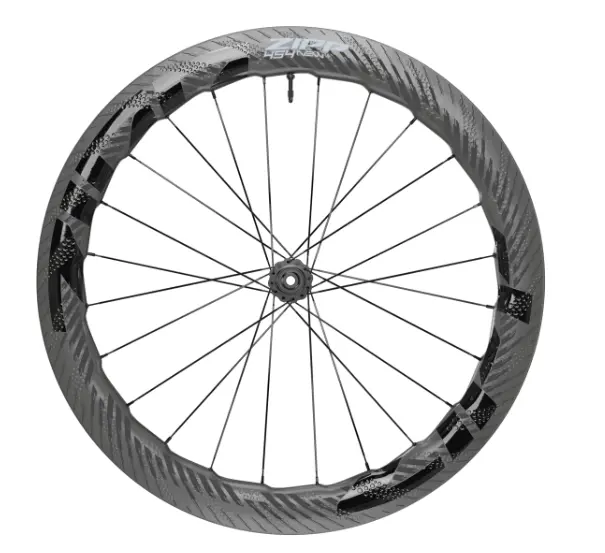
The Zipp 454 NSW has been around long enough that the internet has moved on to reviewing whatever launched last month. That works in your favor if you’re shopping smart. I picked up a set recently for around $1,600 — roughly a third of the $4,450 retail you’d pay for the current production pair — and spent some time thinking hard about whether the technology has actually aged or just the press coverage.
The short answer: the rim hasn’t aged. The hubs are a generation behind. And at that price, neither of those facts changes the conclusion much.
What the 454 NSW Actually Is
The 454 is Zipp’s do-it-all flagship — not the deepest wheel in their lineup, but the one designed to be fast in the real world rather than just in a wind tunnel. The sawtooth rim profile, with its undulating depth between 53mm and 58mm, was engineered specifically to reduce side force in crosswinds. Zipp’s claim isn’t that it’s faster than a 404 in a straight tunnel test — it’s that the 454 carries more of that aero performance into conditions where deeper, flatter-sided wheels start to feel nervous.
The rim is 23mm internally, hookless, and tubeless-only with a 73 psi max. It’s optimized for a 28mm tire, though it runs 30mm and 32mm fine. That internal width is meaningful — more on that in the comparison section.
The current production model uses Cognition V2 hubs, but older sets like mine run the original Cognition. Both use the Axial Clutch mechanism, which disengages the ratchet during coasting to reduce drag — a clever piece of engineering that matters more on long flat roads than it does on punchy climbs. The V2 version refined the engagement speed and reduced friction, but the core concept is the same. You’re not riding a fundamentally different wheel because of the hub generation.
How It Stacks Up Today
The wheel market has moved since the 454 launched, but maybe not in the direction you’d expect.
Roval Rapide CLX III ($3,400 new): The latest Rapide is the most interesting comparison because it represents where the industry went in response to wheels like the 454. Roval dropped 215 grams from the CLX II by switching to carbon spokes and lighter hubs, and they made an unconventional call: 51mm front, 48mm rear — deeper in the front, shallower in the back — based on their own data showing the front wheel delivers 90 percent of the aero benefit. The CLX III is legitimately impressive, but Roval’s own documentation admits it matches the CLX II aerodynamically rather than exceeding it. The gains are in weight, not air. At $3,400, you’re buying a lighter wheel with the same aero profile as its predecessor. The CLX III also returned to hooked rims, which is a choice that runs counter to where most of the market has gone.
Used CLX II sets — the direct predecessor to the CLX III — are trading in the $1,700–$2,000 range, with a 21mm internal width and 1,520 grams including tape and valves. That’s heavier than the 454 and narrower internally. The DT Swiss 180 hubs are a genuine advantage in terms of serviceability and parts availability, but you’re paying more for a used wheel that’s narrower and heavier than what the 454 already is.
ENVE SES 4.5 ($2,800+ new, $1,900–$2,300 used): ENVE holds its used value better than almost anyone, which tells you something about the brand loyalty and reputation they’ve built. The current SES 4.5 runs a 25mm internal width and an asymmetric 50mm front, 56mm rear depth profile. The InnerDrive hub with configurable ratchet engagement — 40, 60, 80, or 100 tooth options — is a nice feature for riders who care about sprint feel. But used SES 4.5 sets at $1,900–$2,300 put you above what you’d pay for a new 454 at current discounted pricing, and the older SES 4.5 generations with 21mm internals aren’t appreciably better than the 454 in any dimension that matters for everyday riding.
Zipp 353 NSW (updated 2025): The updated 353 gets the new ZR1 SL hub with ceramic bearings and a revised carbon layup, shaving around 30 grams via the lighter hub. The rim is the same Sawtooth concept in a shallower 45mm profile. If you want the newest Zipp hub technology, the 353 is where it lives right now — but you’re giving up 8–13mm of depth compared to the 454, which changes the character of the wheel meaningfully.
The Internal Width Question
One number that keeps coming up in this comparison is internal rim width, and it’s worth being direct about why it matters. A 23mm internal width — what the 454 runs — is wide enough to properly support 28mm, 30mm, and 32mm tires without over-pressurizing the sidewall or creating an aerodynamically awkward tire-to-rim transition. A 21mm internal width, which is what the CLX II and older ENVE SES 4.5 generations use, is functional but not ideal for the wider tires most road and gravel riders have moved toward. Roval’s own testing with the CLX III confirmed that a 28mm tire on a 21mm internal rim actually outperformed wider pairings on rolling resistance — but that’s their test setup. The industry consensus has broadly landed on 23–25mm internal as the target range for modern aero wheels, and the 454 has been there since launch.
What You’re Actually Buying Used
If you’re evaluating a used 454, the things that actually depreciate are the hubs and bearings — not the rim. Carbon rims don’t wear in the conventional sense. What you want to know is hub condition, bearing smoothness, and whether the previous owner ran tubeless correctly (dried sealant in a poorly maintained rim can be more annoying than it sounds to clean out). The Sawtooth profile itself doesn’t age out, doesn’t lose structural integrity with normal use, and isn’t going to be obsoleted by a new rim design anytime soon — Zipp is still selling the exact same rim profile at full retail.
The original Cognition hub isn’t a dealbreaker. It’s a proprietary design, which means you’re not swapping in DT Swiss 180 internals if something goes wrong, but Zipp’s warranty and replacement support through SRAM is reasonable, and the Axial Clutch bearings are serviceable. Going in knowing you have first-generation hubs means you can budget for a bearing refresh if needed rather than being surprised by it.
The Verdict
At $1,600 for a used pair of 454 NSW wheels, you’re buying a current-spec rim with an older-gen hub in a market where the alternatives at that price are either a used CLX II (21mm internal, heavier, costs more), a used SES 4.5 (costs more still), or a new mid-tier wheel from a second-tier brand. None of those is obviously better.
The 454 is not the newest wheel on the market. It’s not the lightest, and the Cognition hub doesn’t have the serviceability reputation of a DT Swiss 180. But the sawtooth rim is still Zipp’s flagship aero concept — the same one they’re charging $4,450 for today — and the 23mm internal width means you’re set up for the tire sizes that actually make sense for road and mixed-surface riding in 2025.
The technology hasn’t aged. The price just came down.