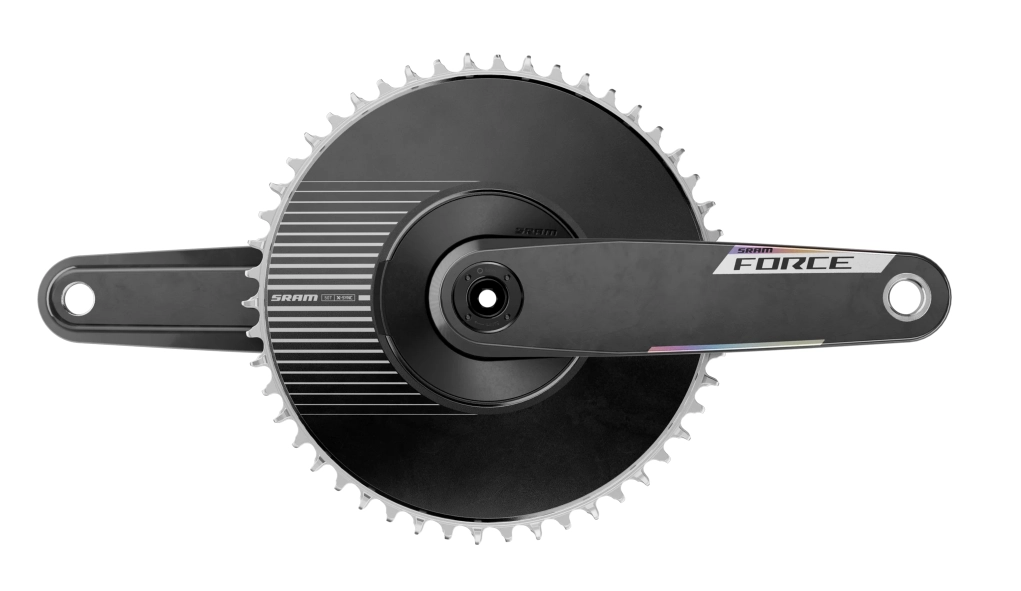
If you’ve been watching professional racing over the last few years, you’ve probably noticed more riders lining up to flat stages with a single chainring up front. Jonas Vingegaard has made it almost a signature — swapping to a 1x setup on stages where the terrain doesn’t demand the range of a full 2x drivetrain. The question worth asking is what those setups actually look like, why pros can get away with them, and whether any of that translates to the rest of us.
What Vingegaard is actually running
When Vingegaard goes 1x on a flat stage, he’s not running an off-the-shelf XPLR gravel group. The typical setup is a large aero chainring — somewhere in the 52-to-56 tooth range depending on the stage profile — paired with a standard road rear derailleur and a 10-36T cassette. The goal is a straighter chainline, marginally better aerodynamics from eliminating the front derailleur, and slightly less weight.
The key qualifier is skilled, powerful rider on a relatively flat stage. On harder mountain days Vingegaard swaps back to 2x. The 1x setup is situational, not universal, and it’s built around the reality that a professional cyclist on a flat stage isn’t going to be grinding a steep climb at 60 RPM. The low end of a 54T/36T combination is still a 1.5 gear ratio — a fairly big gear by most people’s standards, and completely unworkable if the road pitches up seriously.
How that compares to a standard Force E1 2x setup
A Force E1 2x build with a 48/35T crankset and a 10-36T cassette gives you a top gear of 4.8 (48/10) and a bottom of 0.97 (35/36). The strength of 2x is obvious: you have a 12-gear spread on each chainring with meaningful overlap in the middle, so you’re never taking a big jump when you most need a smooth cadence. The front derailleur tradeoff is real but small — some added weight and a touch of aerodynamic drag. On modern electronic groups like Force E1, where the Yaw cage eliminates trim and front shifts happen cleanly, it’s genuinely a non-event to manage.
1x without XPLR: the range problem
You can run a standard Force E1 rear derailleur in a 1x configuration with a 10-36T cassette. The derailleur supports it. But the math puts you in a difficult spot. To get a usable top gear, you need a large chainring — say 46T — which gives you a top of 4.6 but a bottom of only 1.28. That’s noticeably harder to climb than a 2x setup, and there’s no small chainring to fall back on. This is essentially the same situation Vingegaard is in, just with a slightly smaller ring and less power to push it. For most riding it doesn’t work well unless you live somewhere flat.
Where XPLR changes the conversation
Force XPLR E1 is a different system entirely — 13-speed, with a purpose-built rear derailleur that supports a 10-46T cassette. The individual cogs are spaced at 10-11-12-13-15-17-19-21-24-28-32-38-46, which keeps the jumps tight despite the enormous overall range.
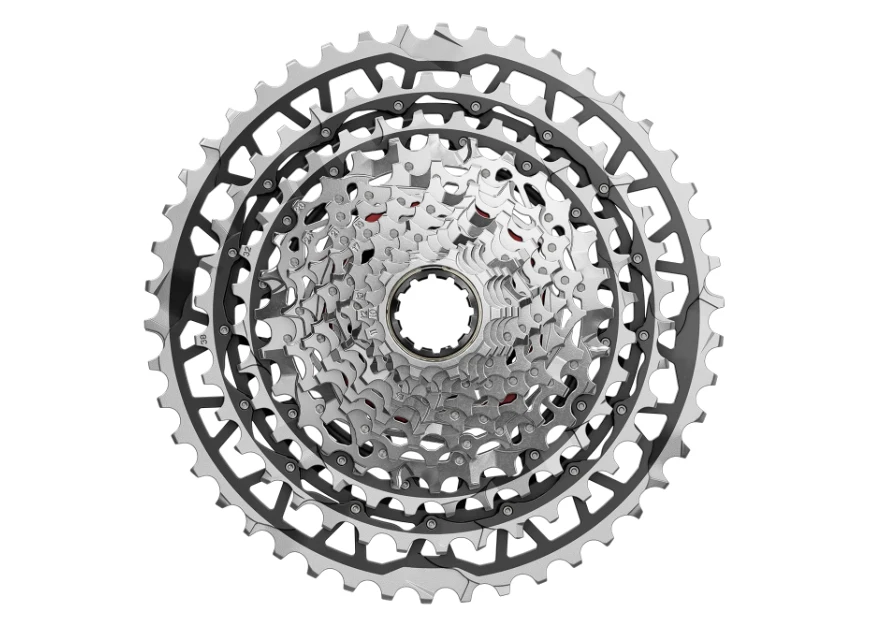
Photo: SRAM
With a 48T chainring your top gear matches a standard 2x setup, and with a 44T you still have a bottom gear that’s easier than anything a 10-36T cassette gives you.

Photo: SRAM
Here’s how the setups compare:
| Setup | Chainring | Cassette | Top Gear | Bottom Gear | Range |
|---|---|---|---|---|---|
| Force E1 2x | 48/35T | 10-36T | 4.8 | 0.97 | 494% |
| Force E1 1x (no XPLR) | 46T | 10-36T | 4.6 | 1.28 | 360% |
| Force XPLR 1x (top-end focus) | 48T | 10-46T | 4.8 | 1.04 | 460% |
| Force XPLR 1x (climbing focus) | 44T | 10-46T | 4.4 | 0.96 | 460% |
The non-XPLR 1x row is what makes the table useful — it shows why standard 1x on road has always been a compromise. You give up bottom-end range compared to both 2x and XPLR, without gaining anything meaningful over 2x at the top. XPLR solves that by adding cogs and extending the cassette range, not by magic.
One catch: you need a UDH frame
Force XPLR’s rear derailleur uses SRAM’s Universal Derailleur Hanger (UDH) interface — it mounts directly to the frame rather than through a traditional replaceable hanger. That means if your bike doesn’t have a UDH dropout, you can’t run Force XPLR. It’s worth checking before you start pricing out the build. UDH has become increasingly common on newer frames, but plenty of bikes in circulation still use a traditional hanger, and there’s no adapter that makes it work.
If your frame doesn’t have UDH, the standard Force E1 1x option is still there, just with the range limitations shown above. For most road riding, that’s a meaningful constraint.
So is 1x worth it on the road?
For most riders, 2x is still the more complete answer. Force E1 2x with a 10-36T cassette covers an enormous range of terrain without compromise, the front derailleur is no longer the headache it used to be, and you’re not giving up anything meaningful in real-world riding.
Where XPLR makes sense is if your riding doesn’t demand sustained high-speed flat performance, if you want a mechanically simpler setup, or if you’re building a bike that genuinely lives between road and gravel. The 13-speed cassette and purpose-built derailleur make it a real system rather than a workaround — but you need the right frame to run it, and you need to be honest about whether the top gear is enough for how you actually ride.
What Vingegaard is doing is interesting to watch. It’s also purpose-built for a flat stage at race pace, swapped off the bike before the mountains. The XPLR version is the one that makes sense for the rest of us — but only on the right bike.