Something is coming from Specialized, and the cycling internet has been trying to figure out exactly what since May 12.
That’s when side-profile images of what appears to be a new Tarmac surfaced on Instagram, posted by an account called @czice_. The shots spread quickly — to BikeRadar, TrainerRoad forums, Weight Weenies, and everywhere else road bike obsessives gather to argue. Two weeks later, a second piece of evidence landed: video footage apparently showing Red Bull–BORA–hansgrohe rider Florian Lipowitz aboard the same bike in Spain’s Sierra Nevada, with the person who posted it writing plainly in the caption, “Yes, that’s new S-Works SL9.”
So there’s a Tarmac SL9. Almost certainly. The harder question is what, exactly, it is.
The leak trail, briefly
The original images drew immediate skepticism because the fork logo appeared to read “Speeialized” — an extra E where there shouldn’t be one. That’s the kind of artifact you’d expect from AI generation or a sloppy render. But it’s also what you’d get from a vertical decal line cutting across the “C” at low resolution. The case against fakery got a lot stronger once the Lipowitz video circulated; a realistic side-profile fake is one thing, but fabricating high-quality video footage of a WorldTour rider mid-training ride in Spain would require a level of effort that makes no sense as a prank.
Specialized hasn’t said a word publicly about any of it.
What the images actually show
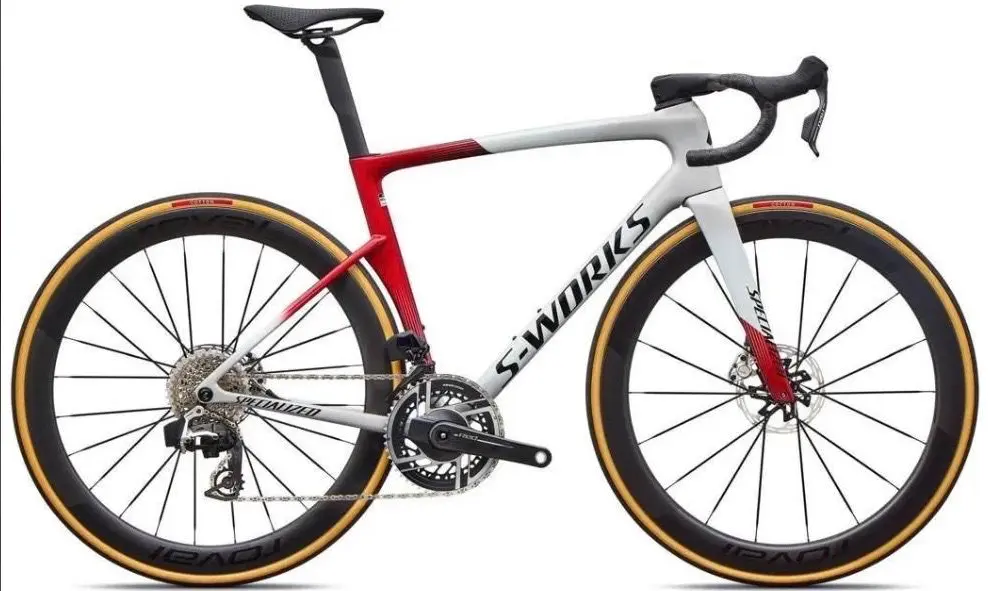
Based on everything that’s leaked — including a full side-profile build shot that has since circulated — the SL9 looks like a focused evolutionary update, but with at least one change more significant than early descriptions suggested.
The most notable thing about the head tube area is what appears to be missing. The SL8’s “Speed Sniffer” nose cone — that polarizing asymmetric protrusion Specialized used to lengthen the effective leading edge without moving the steering axis — looks substantially toned down or gone entirely on the SL9. The head tube transition in the leaked build photo is visibly cleaner and more conventional in profile. Whether Specialized achieved the same or better aero result through a different approach, or simply moved on from the concept, we won’t know until they publish wind tunnel data. But the front end of this bike looks noticeably different from the SL8.
The seat tube and seatpost tell a clearer story. The leaked photo shows a more aggressively aerofoil-shaped seatpost and a revised seat tube junction — deeper, more sculpted, the kind of refinement that yields real drag savings without requiring a new frame platform. The fork crown has also been revised, with a deeper leg profile that smooths the transition into the head tube.
The build in the leaked photo is SRAM Red AXS with flat mount disc brakes, and the wheels appear to be Roval Rapide CLX IIIs — the asymmetric depth profile is visible, with the front rim running noticeably deeper than the rear. The colorway, a red-to-silver fade with tan sidewall tires, looks like a finished launch colorway rather than a test mule. This does not look like a bike that’s months away from being shown.
A Weight Weenies post from February, citing an unnamed Specialized employee, described the SL9 as “a slightly aero optimized SL8” combining “the comfort of the Aethos backend, the aero of the SL7 backend, and an optimized SL8 front.” The photo is consistent with that framing — though the head tube change, if it’s as significant as it looks, may be underselling what Specialized actually changed up front.
What I think the real story is
Here’s what I suspect Specialized is actually doing: holding the line on weight while buying back a few more watts aerodynamically, and positioning the SL9 to remain the one bike you’d race from Monaco to Alpe d’Huez without changing anything.
The SL8 wasn’t the outright fastest road bike when it launched. The Factor ONE, the Cervélo S5, and the Factor OSTRO VAM all beat it on pure aero or pure weight. But the Tarmac’s argument was always that it was close enough to the fastest aero bikes in a sprint and close enough to the lightest climbers on a mountain that you didn’t need both — and it was light enough that it sat right at the 6.8kg UCI weight limit as a complete build. That’s the whole philosophy. “One bike to rule them all” isn’t marketing fluff; it’s an actual engineering constraint Specialized designed around.
The SL9, if the leaks are accurate, looks like an extension of that logic rather than a departure from it. The seatpost and fork revisions target the areas where the SL8 left drag on the table without adding meaningful weight. My read is the SL9 probably won’t be lighter — but it won’t be heavier either, and the aero refinements should narrow the gap to the dedicated aero bikes like the S5 and Y1R without sacrificing the climbing weight that makes the Tarmac what it is.
The Factor ONE at its UCI-limit race weight and the S5 will still beat it in a sprint on the Champs-Élysées on a pure numbers basis. That’s fine. The SL9 just needs to be close enough that the delta doesn’t matter in a race where you’re also going over the Tourmalet.
The CLX III wheel situation
There’s one piece of this story that doesn’t get enough attention: whatever frame changes Specialized makes, the SL9 will almost certainly come specced with the new Roval Rapide CLX III wheels, and those wheels are genuinely interesting.
Roval flipped convention with the CLX III — the front is deeper (51mm) than most comparable wheels from competitors, while the rear is shallower (48mm). Their argument is that the front wheel sees clean air and drives the majority of wheel-related drag, while the rear sits in the turbulent wake of the rider and drivetrain where extra depth earns you almost nothing. The result is a wheelset that comes in at 1,305 grams with claimed aerodynamics matching the CLX II, which weighed 215 grams more.
The carbon aero spokes (developed with Arris Composites), 21mm internal width, and DT Swiss 180 EXP internals round out a package that at that weight and aero profile is going to be at or near the UCI legal minimum on a complete SL9 build. Pair that with a 30mm tire and you’re looking at a setup that’s fast everywhere — aero on the flat, light enough for the climbs, and with enough tire volume to handle variable road surfaces.
That’s the bike Specialized is building toward. A complete S-Works SL9 build on CLX IIIs at 6.8kg is going to be formidable regardless of where the frame lands in isolation.
The Tour timing
The SL8 followed a leak-then-launch pattern in 2023: spotted in Soudal–Quick Step training in July, officially launched weeks later, first raced at the World Championships. Forum whispers from early 2026 pointed to a similar trajectory for the SL9, with “around the Tour” mentioned explicitly in that Weight Weenies post.
The Tour de France starts June 28. Five Specialized-sponsored WorldTour teams are in the mix — Soudal–Quick Step, AG Insurance–Soudal, Red Bull–BORA–hansgrohe, FDJ United–Suez, and SD Worx–Protime. Red Bull–BORA has been flagged as the most likely first team to race it, given Remco Evenepoel is the highest-profile Specialized ambassador in this year’s race. If a launch is coming, the window is very narrow.
Should you wait?
If you own an SL8, nothing in the leaked images suggests a reason to feel shortchanged. The changes look genuine but incremental — not the kind of update that makes your current bike feel slow.
If you’re in the market right now, it’s worth sitting on your hands for a couple of months. The SL8 will get discounted once an SL9 is official, and the SL9 will be available to order shortly after launch. You’re not waiting long, and the decision will be easier once there’s a real spec sheet in front of you.
What the leaks still don’t tell us: actual weights, pricing, or what the complete builds look like below S-Works. Treat any numbers floating around rumor sites as speculation until Specialized puts out a press kit.
Why Specialized usually gets this right
Here’s what separates Specialized from most of the competition: they do the market research, and they actually use it.
Factor builds an incredible bike. Cervélo builds an incredible bike. But both of those brands are fundamentally optimizing for the person who reads every wind tunnel number, compares every gram, and wants to win the spec sheet before they win the race. That’s a real customer. It’s just not most customers.
Specialized has spent decades studying what the broader population of serious cyclists — not just WorldTour teams, but the competitive amateur, the century rider who also does local crits, the person who owns one good road bike and needs it to do everything — actually wants from a flagship. And what that person wants is not the fastest bike in a straight line. It’s the bike that doesn’t make them feel like they made the wrong choice on any given day. The bike that climbs well enough, sprints well enough, handles well enough, and looks the part doing all of it.
The Tarmac has owned that space for two decades because Specialized keeps asking the right question: not “what’s the fastest possible bike” but “what’s the bike that makes the most people the fastest they can be.” Those are genuinely different engineering briefs, and the Tarmac’s answer to the second one is what’s made it the most raced bike in WorldTour history while also being a bike that your club ride friend actually owns.
If the SL9 is what the leaks suggest — a bit more aero, same weight class, same all-around philosophy — then it’s probably going to be the bike most people who are serious about road cycling should actually want. Not because it wins every benchmark category, but because it doesn’t lose any of them badly enough to matter, and Specialized will have engineered the complete package — frame, wheels, tires, integration — as a system that punches well above the sum of its parts.
The road bike market in 2026 has been full of incremental updates that nobody is calling revolutionary. The Canyon Endurace CFR, the new SuperSix EVO, the Giant Propel — solid bikes, all of them, but none of them broke anything. The SL9 appears to fit that pattern too, and that’s fine. The gains at the top end of road bikes are real but they’re small, and the Tarmac’s edge has never been the absolute numbers anyway.
That case will get made on the road, starting somewhere around late June. Until then, everything is still a photograph of someone else’s training ride.
Stay tuned — we’ll cover the official launch when it drops.