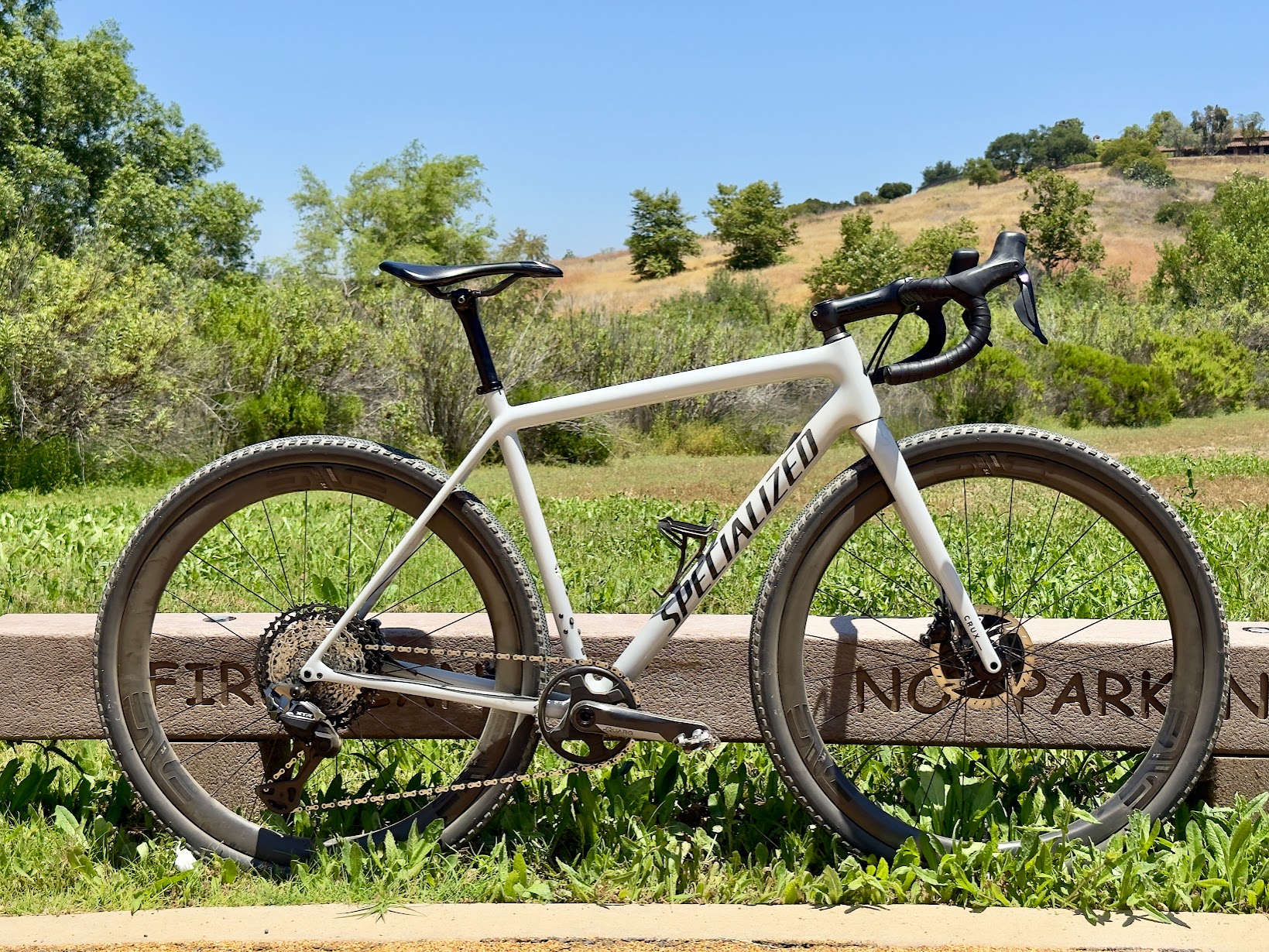
The current Specialized Crux has been around in essentially the same form since 2021. That’s a long time in a category that’s been moving as fast as gravel. Aero gravel bikes have gone mainstream, tire clearance expectations have climbed, and integrated cockpits are now table stakes at the top end. The Crux, for all its strengths — and it’s still one of the lightest gravel bikes you can buy — is showing its age.
A new one is coming. Here’s what we know.
When Is It Coming Out?
The timing points squarely at Unbound Gravel in late May. Specialized has a history of using the biggest North American gravel races to launch major gravel bikes, and the rumor mill has been consistent: the new Crux gets ridden at Unbound, with a public release shortly after in June. There’s already evidence of new Roval gravel wheels appearing in athlete photos, which has been a tell for Specialized launches before.
Don’t expect to actually get one immediately. The gap between when Specialized reveals a new bike and when it ships to customers has been significant in recent years — the new Diverge being a prime example. June announcement, fall availability seems like the realistic timeline.
What’s Actually Changing
Based on converging reports from multiple sources who claim to have seen the bike, here’s what’s coming:
Aero frame. This is the biggest change. The current Crux uses round tubes with no aerodynamic optimization — at race speeds on fast gravel, that costs real time. The new frame is expected to borrow heavily from the Tarmac SL8’s tube profiles. One source who claims to have seen the bike described it as essentially an SL8 with massive tire clearance. Whether that’s literally accurate or just a useful shorthand, the direction is clear: aero-first design language, similar to what Cervelo did with the Aspero and what Factor has been doing.
Fully internal cable routing. The current Crux has external cables at the frame junction points. The new one is reported to be fully internal throughout — cleaner aesthetics, marginal aero benefit, and now an expectation on any bike at this price point.
More tire clearance. The current Crux fits 47mm on 700c or 2.1" on 650b, which was already generous when it launched in 2021. The new one is reportedly specced for 2.2" tires — putting it closer to a hardtail MTB in terms of what you can run. For American gravel racing, where courses like Unbound and Crusher in the Quarry reward big tires, this matters.
New integrated cockpit. An integrated bar/stem combo is expected, paired with the new Roval Terra CLX aero wheels that have been spotted on athlete bikes. The full aero system approach — frame, bar, wheels all working together — is becoming standard at this level.
Downtube storage. Multiple sources mention built-in downtube storage, which the current Crux lacks. The Diverge STR has made this a Specialized calling card, and it would be surprising not to see it carry over to their race-focused platform.
What’s It Giving Up
Nothing comes free. A few things worth flagging:
Weight. The current Crux S-Works frame weighs 725g, which is extraordinary for a gravel bike. Adding aero tube shapes, internal routing infrastructure, and integrated cockpit provisions will almost certainly add weight. How much is the open question — Specialized is good at carbon engineering, but physics is physics. The new bike will almost certainly not be lighter than the current one.
CX compatibility. Sources with shop-level knowledge of the new bike are consistent on this point: it’s not a cyclocross bike anymore. Slacker head angle, lower bottom bracket, geometry optimized for long gravel days rather than punchy CX laps. That’s probably the right call for the market, but if you’ve been using your Crux as a dual-purpose CX/gravel machine, the new one won’t serve that role as well.
Why the CX Roots Don’t Matter Anymore
The original Crux was a pure cyclocross race bike. UCI rules cap CX tire width at 33mm, which requires tight, fast-steering geometry and a high bottom bracket to clear obstacles. That’s a fundamentally different machine from what gravel riders actually want — more tire clearance, more stability at speed, longer reach for all-day comfort.
When Specialized relaunched the Crux in 2021, they already made the call: gravel first, CX second. They added 47mm clearance, adjusted the geometry, and explicitly marketed it as a gravel race bike with CX heritage rather than a CX bike. The new one is taking that evolution further. The “Crux” name carries the brand equity of its racing history, but the bike underneath is now fully committed to gravel.
The broader industry has made the same call. CX remains a legitimate racing discipline, but the volume and growth are in gravel. Brands aren’t going to keep building bikes optimized for a UCI-regulated niche when the mainstream market wants something different.
Should You Buy the Current Crux Now?
If you need a bike soon and the current Crux is on your shortlist, this is the relevant question.
The honest answer: if you’re buying at S-Works level and the new version is a meaningful step forward in aerodynamics and integration, waiting until June makes sense — especially since you’ll likely be able to get a deal on current-gen stock once the new bike lands. If you’re at the Comp or Expert level and weight and price are the primary factors, the current Crux is still an excellent bike that’s unlikely to be significantly undercut by the new model at those build levels.
The new bike will command a premium. It always does at launch.
The Bottom Line
Everything pointing at the new Crux suggests Specialized is doing exactly what the market has been asking for: take the best lightweight gravel platform available, add proper aero tube shapes, bump tire clearance to MTB territory, integrate the cockpit, and show up at Unbound ready to race. If the weight penalty is manageable — and that’s still an open question — it could be the most complete gravel race bike on the market.
We’ll know more in May. Check back here when Unbound drops.