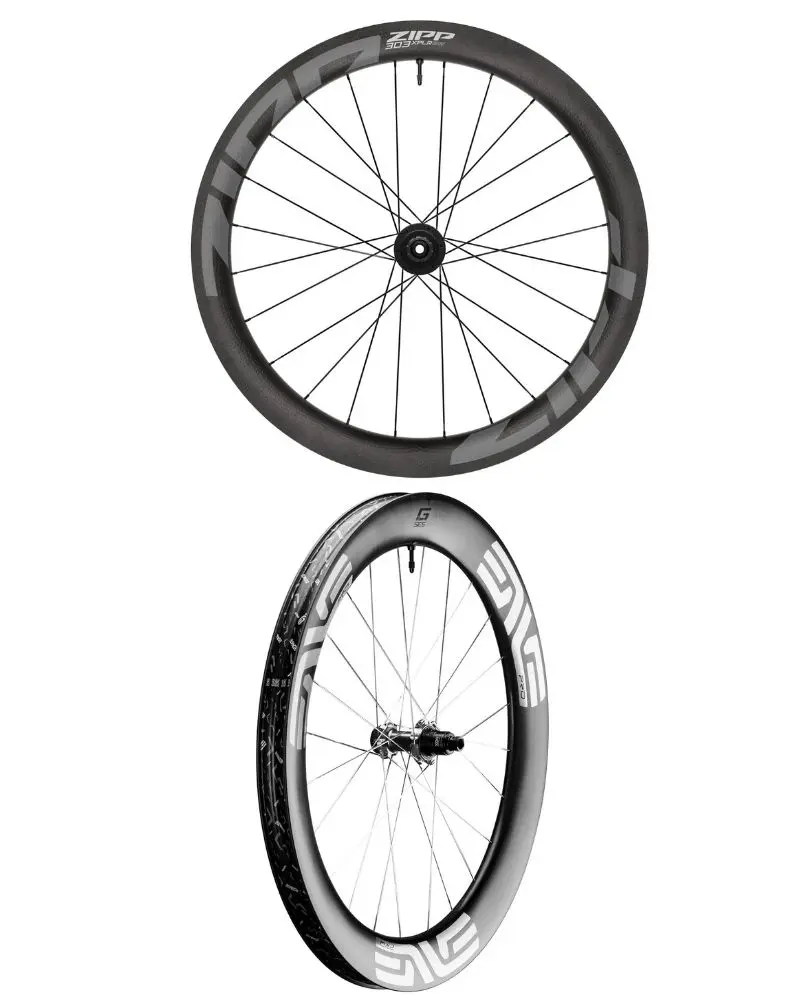
When Zipp launched the 303 XPLR SW in 2024 with a 32mm internal width, it felt like a line in the sand. Nobody had pushed a production gravel wheel that wide before, and the message was clear: the era of putting 45mm tires on 25mm rims was over. Now ENVE has responded with the G SES lineup — and specifically the 6.7 Pro at 35mm internal — and the aero gravel wheel market looks meaningfully different than it did twelve months ago.
This is a straight comparison of where both brands stand right now: specs, pricing, philosophy, and who each wheel is actually for.
The lineups
Zipp has two 303 XPLR variants. The SW is the flagship — dimpled carbon, Sapim CX-Ray bladed spokes, ZR1 hub with 66-point engagement, 1,496g claimed, $2,100. The S uses the same rim dimensions (32mm internal width, 54mm depth front and rear) but steps down to a plain carbon layup, Sapim CX-Sprint spokes, and the simpler 76/176 three-pawl hub, coming in at 1,642g for $1,400. Notably, both Zipps run the same depth front and rear — 54mm across the board.
ENVE has three G SES variants. The base 4.5 is $2,800 a set, the 4.5 Pro is $3,100, and the 6.7 Pro is also $3,100. The 4.5 and 4.5 Pro share 30mm internal rims at asymmetric 49/55mm depths. The 6.7 Pro steps up to 35mm internal at 60/67mm depths. The base 4.5 runs Sapim CX-Ray spokes with a standard 326g Innerdrive hub; both Pro models get Alpina Ultralite spokes and the ceramic Innerdrive Pro hub at 281g.
Specs head to head
| Zipp 303 XPLR S | Zipp 303 XPLR SW | ENVE G SES 4.5 | ENVE G SES 4.5 Pro | ENVE G SES 6.7 Pro | |
|---|---|---|---|---|---|
| Internal width | 32mm | 32mm | 30mm | 30mm | 35mm |
| Depth (F/R) | 54/54mm | 54/54mm | 49/55mm | 49/55mm | 60/67mm |
| Wheelset weight | 1,642g | 1,496g | 1,565g | 1,480g | 1,580g |
| Min tire | 40mm | 40mm | 40mm | 40mm | 44mm |
| Spokes | Sapim CX-Sprint | Sapim CX-Ray | Sapim CX-Ray | Alpina Ultralite | Alpina Ultralite |
| Hub | Zipp 76/176 | Zipp ZR1 | ENVE Innerdrive | ENVE Innerdrive Pro | ENVE Innerdrive Pro |
| Set price | $1,400 | $2,100 | $2,800 | $3,100 | $3,100 |
The internal width question
32mm vs. 30mm vs. 35mm — the number that matters most, and it’s worth being precise about what it actually does. A wider internal rim flares the tire casing outward, increasing actual mounted tire width and creating a more gradual, aerodynamically cleaner transition from rim sidewall to tire. It also changes the sidewall support angle, which affects how the tire behaves at low pressure and how much pinch flat protection you get.
I measured this directly in a Zipp 303 XPLR SW vs. ENVE SES 3.4 width test using a 50c Specialized Tracer TLR on both rims. The XPLR SW (32.5mm measured internal, vs. Zipp’s claimed 32mm) produced 2–2.5mm more actual tire width than the 25mm ENVE rim at equivalent pressures. Scale that relationship to the 6.7 Pro’s 35mm internal and you’re looking at even more stretch — which is great for aero performance but means you need genuine frame clearance before committing.
The interesting middle ground: the Zipp 303 XPLR SW at 32mm sits between the two ENVE tiers. Wider than the ENVE 4.5 and 4.5 Pro at 30mm, but narrower than the 6.7 Pro at 35mm. For riders who want wide but not maximum-wide, and compatibility down to 40mm tires, the Zipp SW is a closer competitor to the ENVE 4.5 Pro than to the 6.7 Pro.
Depth and asymmetry
Both Zipps run a flat 54mm depth front and rear. ENVE uses asymmetric depths across all three G SES models — shallower front, deeper rear. On the 4.5 that’s 49mm front and 55mm rear; on the 6.7 Pro it’s 60mm front and 67mm rear. This isn’t arbitrary: deeper front wheels catch more crosswind, so a shallower front is a real-world handling concession that most riders appreciate on exposed gravel courses. Zipp’s equal-depth approach keeps things simpler but doesn’t address that trade-off.
The 6.7 Pro’s 60/67mm depths are also deep enough to be technically illegal for UCI-sanctioned gravel events. That’s a narrow concern — Unbound, Gravel Worlds, and Traka have no depth limits — but worth knowing if your race calendar includes UCI events.
Tire compatibility
This is where the two brands diverge most sharply. Both Zipp XPLR models require approved tires. The list is built around the Goodyear XPLR Slick and XPLR Inter, with a small number of additional approved options. If your preferred tire isn’t on the list, you’re outside warranty — and outside Zipp’s recommendations. The Goodyear XPLR tires are genuinely good, but being locked into a short approved list is a real constraint, especially as more brands release wide gravel tires.
ENVE publishes recommendations rather than a strict approved list. They’ve done their own blow-off testing across a range of tires including competitors’, and they’re transparent about the methodology. More flexibility, more responsibility on the rider to choose sensibly.
Both brands set the same maximum pressure: 50psi / 3.4 bar. In practice, anyone running these wheels at race speeds on 44mm+ tires is well below that ceiling.
Pricing in context
The Zipp 303 XPLR S at $1,400 is the most accessible entry point in this comparison by a long way. You get the same 32mm/54mm rim as the $2,100 SW, heavier and with fewer freehub options, but the rim itself is identical. If weight isn’t the priority and you only need XDR or Shimano HG, it’s a compelling value — nothing else at this width is close to that price.
The Zipp SW at $2,100 sits in an interesting spot: $700 less than the ENVE 4.5 Pro, $700 more than the ENVE base 4.5. Compared to the 4.5 Pro it’s 16g heavier, 2mm wider internally, and $1,000 less. Compared to the base 4.5 it’s 2mm wider and $700 more, but 85g lighter. Neither comparison is clean, which makes the SW harder to place in the lineup.
The ENVE 4.5 Pro at $3,100 asks you to pay a premium for ceramic hubs, asymmetric depths, and broader tire compatibility. Whether that’s worth $1,000 over the Zipp SW is a personal call — but the gap is real.
The bottom line
Zipp 303 XPLR S — Best value in the category. Same rim as the SW, more weight, fewer freehub options, but $1,400 for a 32mm/54mm aero gravel wheel is hard to argue with. Best for: budget-conscious racers who want wide rims without the premium price.
Zipp 303 XPLR SW — The lightest wheel in this comparison at 1,496g, and the most aerodynamically developed of the Zipp options. The approved tire list is the main friction point. Best for: riders already running Goodyear XPLR tires who want Zipp’s best without paying ENVE prices.
ENVE G SES 4.5 — The entry point into the ENVE G SES range. Slightly narrower than the Zipps at 30mm internal, but asymmetric depths, no tire restrictions, and Sapim CX-Ray spokes. Best for: riders who want ENVE quality and flexibility without going full Pro spec.
ENVE G SES 4.5 Pro — The most versatile option in the ENVE lineup. Ceramic hubs, 1,480g claimed (lightest here), works with tires from 40mm up, asymmetric depths. At the same $3,100 as the 6.7 Pro but 100g lighter and more broadly compatible, it’s the easier daily recommendation. Best for: competitive gravel riders who want the best all-around race wheel.
ENVE G SES 6.7 Pro — A specialist tool. If you have a frame that clears 47mm+ tires, race fast exposed courses, and want the most aerodynamically optimized gravel wheel in production, this is it. Best for: dedicated gravel racers on fast courses with bikes that have the clearance to run it properly.