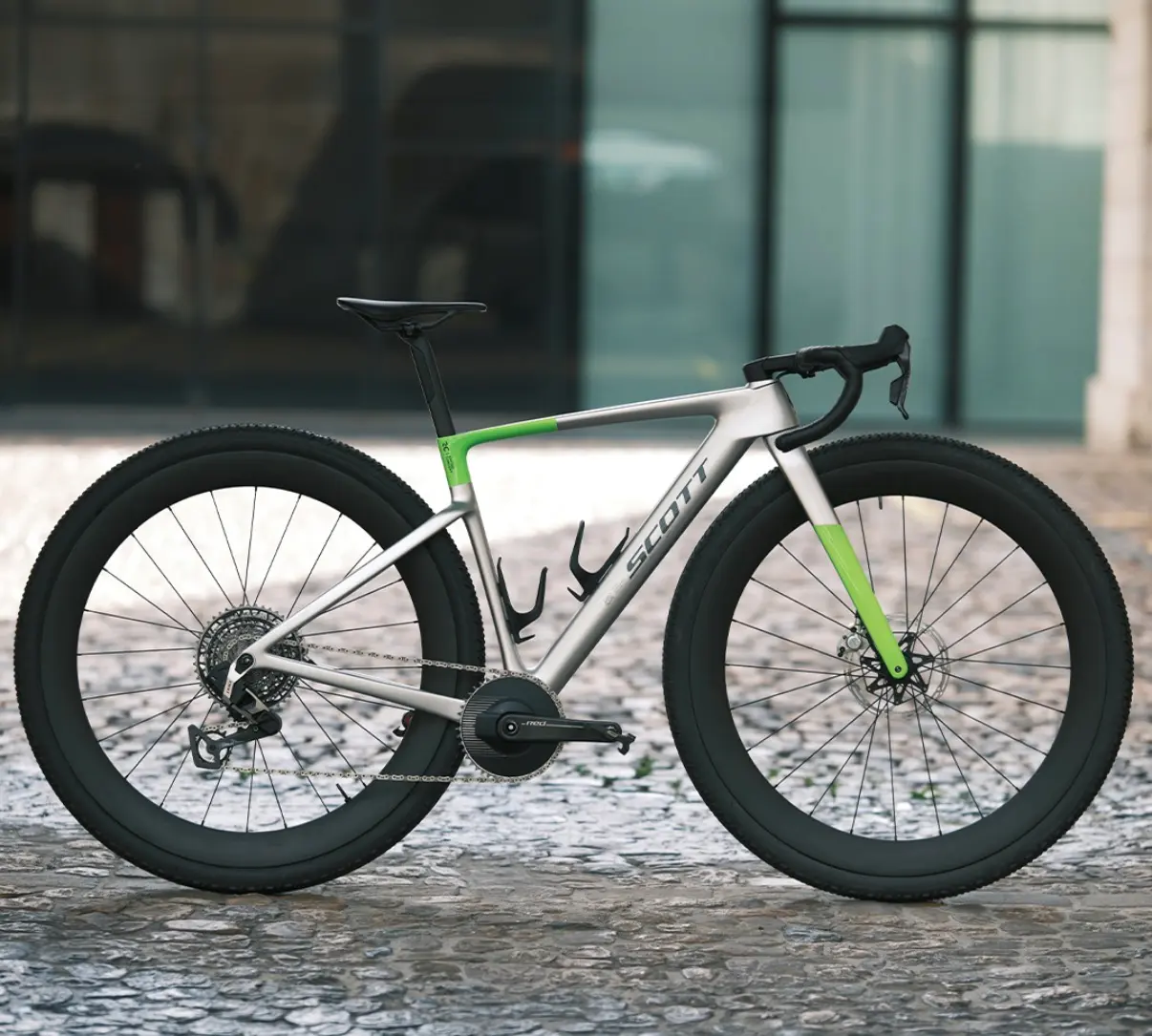
Scott just showed up to Unbound week with a 32-inch aero gravel prototype and two serious athletes ready to race it 200 miles across Kansas. Cameron Jones — last year’s Unbound winner and 2025 Lifetime Grand Prix overall — is aboard one. Robin Gemperle, who won the Tour Divide and Silk Road Mountain Race in 2025, is on the other. These aren’t marketing props. They’re race bikes.
And here’s the thing: while the cycling world has been busy debating whether 32-inch wheels make sense for XC racing, Scott may have accidentally — or deliberately — made the strongest argument yet that gravel is where this wheel size actually belongs first.
XC will get there — it just takes time
Cross-country mountain biking is one of the harder places to debut a radical new wheel standard, and modern World Cup XC courses illustrate exactly why. Today’s XC racing has gotten so technical — tight switchbacks, punchy steep descents, precision lines — that hardtails have nearly disappeared from the top of the field. That’s not a knock on hardtails; it’s just what the courses demand now. Adding a larger, less nimble wheel into that environment makes an already difficult handling equation harder, and the rollover gains get eaten up by the sections where you need the bike to flick and respond quickly.
That said, “harder” isn’t “never.” I watched the 29-inch transition happen in real time, and the early skepticism sounds almost identical to what you hear about 32-inch today. Too big. Too slow to accelerate. Handling is weird. And yet here we are — 26-inch bikes are effectively extinct, and 27.5 only survived as the rear wheel in a mullet setup. The industry moved, riders adapted, and within a few years the old standard looked like a relic.
The component side is already moving on 32-inch. Wheels, forks, and prototype frames are showing up from multiple manufacturers, which means companies are quietly betting real money on this transition. A 32-front, 29-rear mullet seems like the obvious pragmatic entry point — maximum rollover benefit up front, familiar rear triangle geometry and supply chain out back. That’s almost exactly how the 27.5/29 mullet emerged: a middle step that let the industry move without blowing up every existing platform at once.
Gravel strips away most of the objections
While XC works through all of that, gravel is essentially a clean slate for 32-inch — and the performance argument is actually quite clean too.
A larger diameter wheel presents a shallower approach angle to any given obstacle. That means less energy lost to deflection and less fatigue transferred to the rider over a long day. In a 90-minute XC race those gains are real but modest; in a 200-mile gravel race they compound over hours. There’s no suspension system to redesign around the new diameter. No UCI equipment rules constraining wheel size. And gravel courses don’t demand the kind of tight, technical maneuvering that’s pushed XC bikes toward full suspension and away from hardtails entirely — they reward exactly the things a bigger wheel does well: rolling efficiency, momentum retention, and stability on rough terrain at speed.
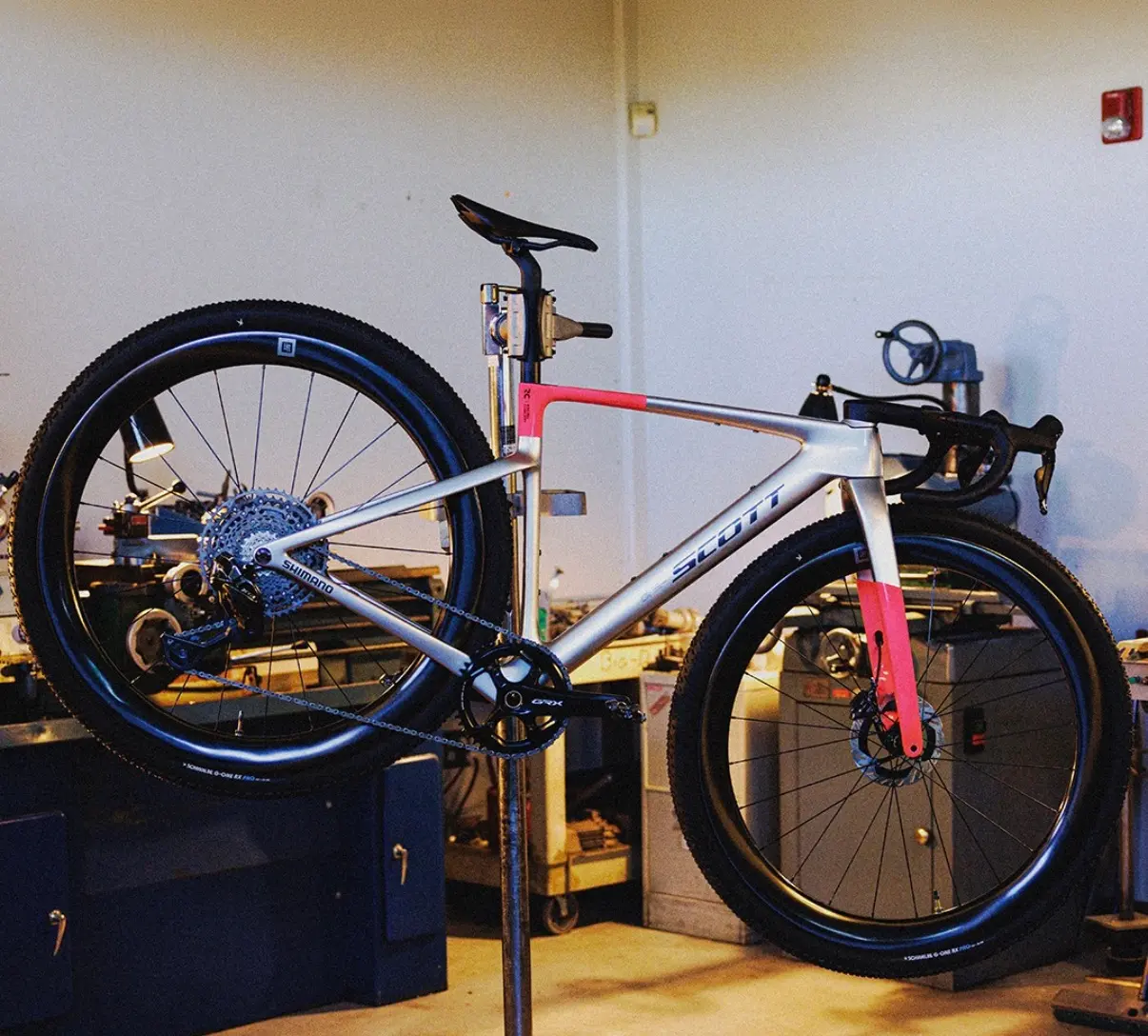
Photo: Scott Sports / Rachael Galipo
Scott’s engineering solution on the prototype reflects how manageable this actually is on a rigid platform. Longer fork, a forward-extended headtube borrowed from their mountain bike playbook, and aero shaping off the fork crown that makes the front end look more like a Foil than a gravel bike. Jones is running 370mm ENVE Aero Road bars and what appear to be custom 55mm-deep carbon rims in the new diameter. Gemperle’s build looks to be on something around 60mm deep. The result, by multiple accounts, looks more like an aero road bike than a graveller — and on a course like Unbound, that’s arguably exactly what you want.
Gravel is the right proving ground
Beyond the pure performance case, gravel is the right place for the market to actually test 32-inch at scale. The gravel world moves faster than XC. There’s no governing body slowing equipment adoption, no complex suspension platforms requiring years of re-engineering, and a rider base that’s already proven willing to experiment — 650b gravel wheels had their moment, plus-size tires came and mostly went, and the category keeps evolving. A new wheel standard has room to breathe here in a way it simply doesn’t in a tightly regulated, technically demanding World Cup discipline.
If 32-inch works at Unbound — really works, not just “didn’t blow up” but actually contends — the conversation shifts fast.
The real test is this weekend
Scott says these bikes will never be sold. “Emporia-only,” they called them. The cycling internet’s response was more or less a collective eye-roll — the comments sections seem pretty convinced Scott’s “never” has an asterisk on it. And honestly, that’s the right read. That’s what every prototype program says before a wheel size wins a major race and the product roadmap quietly shifts six months later.
Jones and Gemperle are two of the most credible endurance athletes in the sport right now. If either of them finishes at the front on 32-inch wheels at Unbound, this stops being a prototype conversation. And unlike XC — where the infrastructure for a new standard is enormous and slow — the gravel world could turn this around in a season or two. New frames, new wheelsets, done.
XC will probably get to 32-inch eventually. History says it will. But gravel might just beat it there — and Scott is making sure they’re first to find out.